The human right to…dream of peace…

“Il faut que les femmes et les hommes de ce pays se redonneront le droit de rêver à un monde plus juste! (Women and men of this country must allow themselves the right to dream of a fairer world!)” – Françoise David, 2011 (cited in HERSTORY 2012, The Canadian Women’s Calendar, p. 104, Saskatoon Women’s Calendar Collective; here)

Françoise David is a social-justice activist. Do you remember, or know of, her in recent Canadian history? (Click here for more info.) One of the many dreams that she has realized in her life, thus far, was the 1995 March of Women Against Poverty – known in French as the “Du pain et des roses” march to a rally in Québec. The reference to “Bread and Roses” recalls the 1912 textile-workers strike in Lawrence, Massachusetts during which immigrant workers (many of them, women) called for fair wages and dignified working conditions (click here, here, and here). [Click here for an international news report titled, “The Cry for ‘Bread and Roses’ Continues”, regarding International Women’s Day (2012) and citing Palestinian women’s efforts at the Qalandiya Checkpoint area between Ramallah (in the occupied West Bank) and occupied East Jerusalem; see the 5-9-minute mark of the video.]

I regard Françoise David’s observation as a reminder that we, as Canadians, need to permit ourselves to realize our right to dream of a fairer world… At this turning of the year – from 2012 to 2013 – and as we begin a new era of world history (part of ‘the great turning’, click here), we look in our collective mirror and realize that we are losing touch with our dream of participating as ‘peaceful’ citizens in the global village…

Under the current federal government, Canada is growing increasingly militarized (listen to this interview here). And in this way, we begin to resemble ‘our best friend’ (here):  Israel.

“There is a saying in Israel, passed from one generation to the other: ‘Don’t worry, by the time he will be eighteen, He won’t have to go to the army. We will have peace by then.’ And then you have another war. -Eran Shakine 2009” (click here and here)

Eran Shakine. Julie M. Gallery.Toronto - Oct. 2009 - Photo: Sherry Ann

Eran Shakine. Julie M. Gallery.Toronto – Oct. 2009 – Photo: Sherry Ann

Israeli society is highly militarized; from kindergarten age, children are prepared for the mandatory draft into the Israeli Defense Force (IDF). New Profile (Movement for the Civil-ization of Israeli Society; click here) is a group that helps Israelis to see how they are being socialized toward militarism (e.g., in consumer ads) (click here). In the recent Israeli government’s attack on Gaza (November 2012), 75,000 reservists were ordered to report for duty; about 50,000 showed up.

Throughout Israel’s 65th year of existence (here), many people have sought refuge there with a dream of home. Yet, a proportion of Israelis have seen that dream dashed as they watch their government and army shift from one of defence to one of occupation. Of those Israelis, some have leaned into their right to dream anew, of peace. They have acted on that new dream by refusing to serve in the IDF. See these links for helpful overviews of the ‘refuser’ movement (here and here). A recent chapter of this dream has been led by high-school students in Israel. Starting in 2001, the Shministim (high school seniors) Israeli Youth Refusal Movement began, and continues, most recently with this young leader: “Natan Blanc, 19 years old from Haifa, arrived, Sunday, 22 Dec. 2012 , to the Induction Base in Tal-hashomer, where he again declared his refusal to serve in the Israeli Army. He was sentenced to 14 days of imprisonment for his refusal in the military prison No. 6 near Atlit.” (This is Natan’s third imprisonment; see more information and how to take action here. See additional articles here and here regarding other conscientious objectors in 2012.)

In early 2011, I had an opportunity to meet Sahar, a few times. She was the first woman in the 2008 group of Shministim to be imprisoned. Here is part of her story, as I recorded it. See this link for her own statement of refusal.

Sahar - West Jerusalem - 2 Feb. 2011 - Photo: Sherry Ann

Sahar – West Jerusalem – 2 Feb. 2011 – Photo: Sherry Ann

Sahar was born in August 1990. She was aware as a 12 or 13 year old of the movement against the occupation. Her father was an activist with the Second Intifada which started in 2000 (here). He took her tree planting (a peaceful form of activism; here) and she asked to go to more serious events. She was young. She did go to Bi’lin (a village in the occupied West Bank) for two years for the weekly demonstrations. She met those who refused to serve with the Israeli Defense Forces (IDF) in 2005; she attended demonstrations supporting them.

In 1979, the first group of Shministim refused to serve in the occupied Palestinian territories (oPt). At that point in time, the term, Shministim, gained the connotation of refusenik. In 2001, Shministim was used as a term again. In 2001-2003, a few dozen Shministim were involved. A high-profile trial occurred. Five students went to jail for two years (the maximum sentence). That was the only time that a court martial of Shministim refusers has occurred. In all other cases, the IDF has used “administrative proceedings”; it’s a mechanism of the army.

Sahar was aware of the Shministim refuser movement prior to high school. She knew that she would be drafted in 2008 and began to organize with other students in 2007. They wrote to each other and others to raise awareness. One hundred people signed their Shministim letter.

In August 2008, ten people chose to go to prison. Sahar was one of the ten and was the first woman in her Shministim year to refuse IDF service. Her draft date was 25-26 August 2008. She was in prison for two months and in detention for three months.

Note: Orthodox-Jewish boys who study in Yeshiva for a minimum number of years are automatically exempt from IDF service. Palestinians who live in Israel are exempt. Religious Jewish women/girls are exempt although they have to submit a request for exemption.

Sahar described to me how a person may be exempted from IDF service:

1)      Secular Jewish society – 12% of potential draftees are exempted based on “mental health”. In the 11th and 12th grades, students undergo physical and IQ tests. Then, the army decides each student’s unit assignment. In the midst of this process (yet before being drafted), a student can ask to see a mental-health officer. For some units, meeting with a mental-health officer is automatically part of the process. Typically, the label that is given to some of the potential draftees is “depressed”. Given the pressure of the army with its strict system and then given the access to weapons, the army considers this a bad combination (i.e., increased risk of suicide). A primary task of the mental-health officer is to determine the suicide potential of draftees, because the army is responsible if a soldier commits suicide (i.e., an inquiry must occur). Yet, this route is “an easy backdoor” for young people. In effect, the majority of the 12% seeking exemption based on mental health are exempted.

2)      Conscientious Objection – The army has a Conscientious Objectors Committee (with a membership of 8-10 soldiers and one civilian). Pacifism is given as the reason for seeking exemption; applicants must convince the Committee that service in the army is amoral. Applicants will not receive exemption for political reasons.

3)      Incompatibility – Only the army may decide if a person is incompatible with the purpose of the army. A person cannot request this status. A person may be deemed incompatible for such reasons as a criminal record, drug use, dropping out of school, prior service in a military prison.

In 2008, 100 students signed the Shministim letter; only 10 went to prison. Probably, the others went the mental-health route. In effect, going to prison is a choice. Personally, Sahar didn’t want out on a mental-health reason. She did not want to lie about her beliefs. She chose to use the prison to raise awareness about the issues of the occupation. And at the same time, “we decided as a group that we have no reason to sit in prison forever.” “The normal process would be to show up on Draft Day (i.e., your 18th birthday) and indicate that you refuse the draft process and that you will not go. Then, on that same day, you go to trial with one officer; you are accused of refusing an order because you are a soldier as of that day. We were sentenced as soldiers. Usually, you would get between a week and a month; that depends on the officer in charge. [Sahar was initially given one week and then was released.] Then, you get a letter requesting that you return to base, because you are still a soldier. You go back and refuse again. They you try, again.” Sahar spent one week in prison, then one week in detention. Then she was AWOL [away without leave] for two weeks, at home. Then, she was in prison for three weeks. In total, she was in prison or detention for five months. She was exempted/released in January 2009.

As a group, the intention isn’t to fight the army and to sit in prison. The idea is to try and get out. All 10 of the refusers in 2008 hoped to get out on a charge of incompatibility because they perceived that as a path of integrity. Since 2005, none of the Shministim refusers have been released on incompatibility. Rather, they’ve been released on mental-health reasons. For Sahar, on her forth visit with the Mental-Health Officer, she was given a medical profile (i.e., “Profile 21”).

After being released, people live in three types of bubbles:

(1)   In Tel Aviv which is a secular Jewish city with the lowest enlistment rate.

(2)   Abroad (e.g., in Europe).

(3)   In an activist bubble – Sahar lives half-time in Jerusalem (which she describes as not very left-oriented, politically) and half-time in a developing town (where the Israeli government puts new immigrants; which she describes as being very far from left-oriented).

Sahar notes that, in Israeli society, individuals who refuse to serve in the IDF may continue to experience marginalization. For example, for a 20-year old upon release from the army, a typical question is not “How old are you?” but “What did you do in the army?” For 18-20 year old refusers, getting work can be hard due to huge social discrimination based on “We need workers after the army”. Legally, employers are not allowed to discriminate based on army service though job application forms may well ask about army service. For some refusers, getting a driver’s licence may be difficult due to their ‘mental-health’ refusal status.

What will Israeli society choose in the upcoming elections on 22 January 2013? Here are a few links to articles to help sort through the various players in these elections (here, here, here, here, and here). Recently, the Israeli Central Elections Committee tried to disqualify MK (Member of the Knesset) Hanin Zuabi’s candidacy for the 19th Knesset; she is the only Palestinian woman member of the Knesset and participated in the Freedom Flotilla to Gaza in 2011. Concern exists that this was an attempt to silence the minority Palestinian voice within the state of Israel (i.e., Palestinians with Israeli citizenship, though it is a marginalized, second-class status; they live in Israel, not in the occupied territories). On 30 Dec. 2012, the Israeli Supreme Court declared that MK Zuabi would be permitted to participate in the upcoming elections (here and here); this is a hopeful sign.

As Canadians, we have some obligation to follow these elections given that the Canadian federal government is so closely tied to the current Israeli government (see an article here). How will we respond to this ‘best friend’ (here)? How might we be conscientious observers?

We have a right…to dream… To dream and act conscientiously. See this video (here) for an instance of young Israelis daring to dream, and act in support, of a fairer world – to end the Israeli government’s occupation of Palestine; Sahar appears at the 2-minute mark of the video. By dreaming, we imagine the possibilities…

Listen – can you hear voices singing the words of the poem and song, “Bread and Roses”… “Hearts starve as well as bodies – give us bread and give us roses…” (here, here – Mimi Fariña wrote the song, and here ).

Let’s dream of, and thereby, realize a peaceful and beautiful world…at home and globally… in 2013…

Human Rights Day – 10 Dec. 2012 – Stand up today…

Today is the international day for Human Rights (click here). How will you mark this day? Yes, you, as a global citizen, possibly, too, as a Canadian citizen. An individual who has Canadian citizenship. You have a voice, distinct from the Canadian government. How will you use your voice?

On 29 Nov. 2012, the federal government of Canada chose, in effect, not to support human rights when it voted against a resolution in the United Nations’ General Assembly for the promotion of Palestine to a non-member, “enhanced observer” status at the UN. Canadians for Justice and Peace in the Middle East (CJPME) describes that the Israeli government lobbied “…European governments, [and] the majority of these governments voted in favour, including heavyweights France, Norway and Spain, as well as Austria, Denmark, Finland, Greece, Iceland, Ireland, Luxembourg, Sweden, Portugal, and Switzerland. The resolution passed by a wide majority, with 138 of the UN’s 193 UN members voting in favour, 9 opposed (including Israel, the US, Canada) and 41 abstentions.” (see the full CJPME statement here)

On 13 April 2011, leading up to the most recent Canadian, federal election, I posted the following on my blog:  “In voting against resolutions of the United Nations Human Rights Council condemning Israel’s violations of Palestinian human rights, Canada has also failed to live up to its obligations to uphold respect for international human rights and humanitarian law.” (Federal Election Kit, 2011, The United Church of Canada, p. 20)

After the UN vote on 29 Nov. 2012, the Israeli government declared it would build 3,000 new housing units in occupied East Jerusalem and the occupied West Bank (click here). As reported in Haaretz on  30  Nov. 2012 by Barak Ravid (here), “… According to the [senior diplomatic] source, Israel also plans to advance long-frozen plans for the E1 area, which covers an area that links the city of Jerusalem with the settlement of Ma’aleh Adumim. If built, the controversial plan would prevent territorial contiguity between the northern and southern West Bank, making it difficult for a future Palestinian state to function. In the beginning of his term, Prime Minister Benjamin Netanyahu gave the Obama administration a commitment that Israel would not build in the area. Both of his predecessors, Ariel Sharon and Ehud Olmert, also promised the U.S. administration that Israel would not build in E1.” For a description of the significance of the E1 area, click here.

On 13 April 2011, I also wrote the following: “Israel occupied East Jerusalem along with the West Bank in 1967. Occupation is regarded internationally as a temporary situation. Permanent changes in occupied territory are not allowed except for military necessity or to benefit the local population (Article 43, Hague Regulations). Destruction of property is not allowed (Article 53, Fourth Geneva Convention). Confiscation of property (Article 46, Hague Regulations) is not allowed. The forced displacement and inhumane treatment (e.g., denying essentials like water) of the local population is…not allowed.

However, Israel began its self-declared, illegal annexation in 1967. Using force, it expanded the municipal boundaries of East Jerusalem by annexing 28% of West Bank. The Israeli government has been moving its citizens into occupied East Jerusalem. This is population transfer and is a war crime [Article 49(6), Fourth Geneva Convention]. The Israeli government’s construction of the Separation Barrier (Wall) to the east of the internationally recognized Green Line (i.e., the 1949 Armistice line following the declaration of the state of Israel) is also illegal (International Court of Justice, 2004; click here, p. 3). Finally, house and infrastructure demolitions  are a war crime because they are a grave breach of the Geneva Conventions (click here and here).” (see my full posting here)

As reported today by Vicky Tobianah in Haaretz, ““This [Canadian] government has essentially walked away from the UN,” says [Alistair] Edgar [a political science professor at Wilfred Laurier University in Ontario, Canada and executive director of the Academic Council on the United Nations System]. “We have withdrawn from UN peacekeeping, turned down requests to engage in new peacekeeping operations, we are cutting our funding to overseas development and narrowing the number of countries we give money to.”” (click here)

With each passing day, the current Canadian government is revealing its stance. What will your stance be?

Check out these opportunities for action:

CJPME’s action alert (here)

US Campaign to End the Israeli Occupation – Marking Human Rights Day (here)

Commentary from Ada Glustein from Building Bridges Vancouver, a non-partisan, non-sectarian organization which aims to provide a forum for dialogue and information concerning the long-standing conflict in Israel-Palestine (here)

Media release, Independent Jewish Voices Canada (click here)

Media release, Amnesty International (click here)

Commentary from Hanan Ashrawi – on the side of international law (here)

A non-violent approach? How dare you!

Yesterday (click here), the Palestine Liberation Organization (PLO), led by Mahmoud Abbas (Chairman of the PLO and President of the Palestinian Authority), submitted a resolution to the United Nations’ General Assembly for the promotion of Palestine to a non-member, “enhanced observer” status at the UN. A decision is expected on Thursday, 29 Nov. 2012. You may remember that, in Fall 2011, the Palestinian Authority applied for full-member status (based on pre-June 1967 borders) with the UN. In Nov. 2011, the Security Council (under pressure from such players as the United States) did not achieve a unanimous response (click here and here) and the process stalled.

As you will see in my links to various news articles, some analysts are commending this current application as a non-violent action in response to the Israeli-Palestinian conflict. Why, then, would Canada be pressuring the Palestinian Authority to stop this application (click here), with a threat to end funding aid?? Essentially: stop this non-violent action, or else! (click here) Since when did and how has this become a Canadian position?? (Consider this resource by Marci McDonald for additional background.)

Note: Palestine does not have independent statehood in international-relations terms. Palestinians are stateless. With their current “permanent observer” status, Palestinians cannot access the International Criminal Court (ICC). With “enhanced observer” status, Palestinians would be able to apply for access to the ICC. Israel and the United States have actively worked to prevent Palestinian access to the ICC (click here , here, and here). Imagine if such access existed… why, this would be another non-violent response to the Israeli-Palestinian conflict…a way into examining the Israeli government’s violations of international humanitarian law (see an excellent analysis here). Imagine…

“Indeed, as the latest Gaza conflict begins its inevitable winding down, it will become increasingly apparent that Israel’s continual deployment of large-scale, indiscriminate force against people and space of Gaza – and, equally important, the West Bank as well – constitute not merely the context for war crimes but for crimes against humanity and, because of their clearly aggressive nature, a crime against peace. Hamas and Palestinian forces responsible for launching rockets at Israel will also have to reckon with the legal, political and moral consequences of their ongoing resort to violence, and the massive and disproportionate Israeli response they invariably produce.” (Mark LeVine & Lisa Hajjar, 21 Nov. 2012; see the full article here.)

Actions: From Canadians for Justice and Peace in the Middle East (here)

Please take 30 seconds to show solidarity with the Palestinians before UN General Assembly vote

Thursday, Nov. 29th, the Palestinians will take their bid for statehood to the UN General Assembly, after it was blocked last year by the US in the Security Council.  It will likely pass, and if it does, the Palestinians will have important new tools to use in pursuit of their self-determination and human rights.  A few important states* are wavering, and you can make a difference.

First, click here to send an email to your MP expressing your support for Palestine’s bid.  Then forward this email to a friend.
Then please join in and do your part in one or more of the following ways:

1. If you did not do so above, participate in our action alert to Canadian political leaders. Click here to send your email now.

2. Send a hard-copy letter to your MP. Please click here to open a letter in an editable PDF format to send to your Member of Parliament. Click here to find out who’s your MP.

3. Participate in Avaaz’s action alert to the leaders of European nations.  Strong support from Europe will be important in Palestine’s quest.  Click here to watch an excellent video prepared by Avaaz on the Palestine issue, called “Middle East Peace – The real story”. Then click here to send your email.
4. Meet your MP. Walk them through our FAQ document on Palestinian statehood as well as our talking points. To find the contact information for your MP, please click here.

5.Sign up to CJPME’s Media Centre, and participate in our media alert network. We are closely monitoring the media during this period, and additional participants can help out greatly. Click here to watch an overview video. Click here to sign up as a media responder.

Together, let’s make Canada the champion of human rights that it should be.  Thanks for your support to the rights of the Palestinian people!
The CJPME Leadership
CJPME Email – CJPME Website

* Unfortunately, Canada is poised to oppose the Palestinian bid at the UN.”

The conflict lives here, not just ‘over there’…

Why should Canadians care about the 60+ years of the Israeli-Palestinian conflict? Why should we concern ourselves with what happened ‘over there’ during the past week and a half? Why should we be interested in the permit system that the Israeli government has imposed on people living in the occupied Palestinian territories? It’s not as though we’ve had a ‘say’ in it… that Canada’s colonial pass-and-permit system imposed on Aboriginal peoples in the late 19th-early 20th century served as a point of reference for the South-African apartheid system or that in turn, the South-African apartheid system served as a point of reference for the Israeli permit system that restricts freedom of movement and is separating two societies [in other words: apartheid, which means apart-ness (here), separation (here); also, here]. It’s not as though we’re living with the effects of apartheid right now in a society that ignores what the United Nations declares as unacceptable (e.g., food insecurity among Aboriginal peoples, here). Actually, I perceive that we are living with effects of apartheid;  the socio-structural impact is horrific regarding living standards among many First Nations, Métis, and Inuit peoples on Turtle Island…

It’s not as if the Israeli-Palestinian conflict is simply ‘over there’… We just need to open our eyes and ears to see and hear the voices of Canadian-Israelis (e.g., Lisa Goldman, click here) and Canadian-Palestinians (e.g., Rafeef Ziadah, click here) who are seeking an end to the Israeli government’s occupation of Palestine… To help clarify understanding about the nature of the conflict, see these 10 myths as identified by Israeli historian, Ilan Pappe (here and here)…

Didn’t a Canadian (Marshall McLuhan – born in Edmonton, Alberta) anticipate how we would all become a global village (here)? We are all part of this conflict… let’s start responding and taking action whenever and wherever we can…

Action: Please share this posting and the links to the thoughtful voices that are out there…share this with family, friends, on Facebook, Twitter…

On the edge of what? How might Canada help rather than hinder peace…

Is the ceasefire holding? Some say that it is (click here), despite at least two shooting incidents (here). Much discussion is underway regarding: (a) who has benefited from this recent aggression (here) and (b) the longevity of this ceasefire and the persistence of non-violent resistance to the Israeli-Palestinian conflict (here and here; this interview is part of Harry Fear’s coverage from Gaza).

What saddens me is what appears to be happening now that the world media is turning the public’s attention to other news items. The Israeli government continues with indirect structural violence in the occupied West Bank and East Jerusalem and a new wave of arrests and administrative detentions of Palestinians – without charge or trial (click here).

Today, Canadians for Justice and Peace in the Middle East (CJPME) shared this report (here) from Steve Hibbard (Nov. 2012) regarding the shift in Canada’s Middle East Policy during Prime Minister Harper’s leadership. Hibbard sees the potential for Canada to contribute in this ambiguous moment: “Perhaps the most helpful step Canada could take would be to use its close ties with Israel to work with Israelis and Palestinians to build mutual trust. Mutual trust is one of the requirements for an Israeli-Palestinian settlement which in turn is the key to a broader Middle-East peace.” (p. 13)

CJPME released this statement (here) that asks Canadian Members of Parliament (MP) to end a silence that many of them have held…for too long. Please write to your MP.

Click here for a list of gatherings near you in the coming days.  If you are in Edmonton, note this opportunity: A film screening and panel discussion on Wed., 28 Nov. 2012 regarding “What Comes Next for Gaza?” (click here)

Ceasefire – cease fire – now, breathe…

Breath…that’s what we share…

A ceasefire between the Israeli government and Hamas has been announced. See the full text here and a Reuters article here.

Too many people have died. Too many people are wounded. Too many people are full of fear…

Now, let’s breathe…together…focus on that – only on the breath

to carry this ceasefire into the next breath, and into the next…

I invite you to pause to watch this video (here) for five minutes…breathe…and listen to Rumi’s “Only Breath” poem from 900 years ago…

Breathe…

A different type of resistance…through relationships

Imagine a different type of resistance – moving away from competition toward a shared effort of planning together for a shared future… Other Voice (here) is doing just that. Click here for their petition (or if you do not have a Facebook account, click here). In early 2011, I met Roni Keidar, a member of Other Voice who lives near the Gaza border.  I also met Eric Yellin, a member of Other Voice, and the originator of the petition. See their photo at this posting (here).

Amira Hass describes well the difference between two types of resistance in the following article. She is a journalist with Ha’aretz (click here). She is a Jewish Israeli who has lived in the occupied Palestinian territories. (Click here for links to additional articles by Amira Hass.)

Israel’s right to self-defence a tremendous propaganda victory

By Amira Hass  | Nov.19, 2012 

One of Israel’s tremendous propaganda victories is that it has been accepted as a victim of the Palestinians, both in the view of the Israeli public and that of Western leaders who hasten to speak of Israel’s right to defend itself. The propaganda is so effective that only the Palestinian rockets at the south of Israel, and now at Tel Aviv, are counted in the round of hostilities. The rockets, or damage to the holiest of holies – a military jeep – are always seen as a starting point, and together with the terrifying siren, as if taken from a World War II movie, build the meta-narrative of the victim entitled to defend itself.
 
Every day, indeed every moment, this meta-narrative allows Israel to add another link to the chain of dispossession of a nation as old as the state itself, while at the same time managing to hide the fact that one continuous thread runs from the 1948 refusal to allow Palestinian refugees to return to their homes, the early 1950s expulsion of Bedouin from the Negev desert, the current expulsion of Bedouin from the Jordan Valley, ranches for Jews in the Negev, discrimination in budgets in Israel, and shooting at Gazan fishermen to keep them from earning a respectable living. Millions of such continuous threads link 1948 to the present. They are the fabric of life for the Palestinian nation, as divided as it may be in isolated pockets. They are the fabric of life of Palestinian citizens of Israel and of those who live in their lands of exile.
 
But these threads are not the entire fabric of life. The resistance to the threads that we, the Israelis, endlessly spin is also part of the fabric of life for Palestinians. The word resistance has been debased to mean the very masculine competition of whose missile will explode furthest away (a competition among Palestinian organizations, and between them and the established Israeli army ). It does not invalidate the fact that, in essence, resistance to the injustice inherent in Israeli domination is an inseparable part of life for each and every Palestinian.
 
The foreign and international development ministries in the West and in the United States knowingly collaborate with the mendacious representation of Israel as victim, if only because every week they receive reports from their representatives in the West Bank and Gaza Strip about yet another link of dispossession and oppression that Israel has added to the chain, or because their own taxpayers’ money make up for some of the humanitarian disasters, large and small, inflicted by Israel.
 
On November 8, two days before the attack on the holiest of holies – soldiers in a military jeep – they could have read about IDF soldiers killing 13-year old Ahmad Abu Daqqa, who was playing soccer with his friends in the village of Abassan, east of Khan Yunis. The soldiers were 1.5 kilometers from the kids, inside the Gaza Strip area, busy with “exposing” (a whitewashed word for destroying ) agricultural land. So why shouldn’t the count of aggression start with a child? On November 10, after the attack on the jeep, the IDF killed another four civilians, aged 16 to 19.
 
Wallowing in ignorance
 
Leaders of the West could have known that, before the IDF’s exercise last week in the Jordan Valley, dozens of Bedouin families were told to evacuate their homes. How extraordinary that IDF training always occurs where Bedouin live, not Israeli settlers, and that it constitutes a reason to expel them. Another reason. Another expulsion. The leaders of the West could also have known, based on the full-color, chrome-paper reports their countries finance, that since the beginning of 2012, Israel has destroyed 569 Palestinian buildings and structures, including wells and 178 residences. In all, 1,014 people were affected by those demolitions.
 
We haven’t heard masses of Tel Aviv and southern residents warning the stewards of the state about the ramifications of this destruction on the civilian population. The Israelis cheerfully wallow in their ignorance. This information and other similar facts are available and accessible to anyone who’s really interested. But Israelis choose not to know. This willed ignorance is a foundation stone in the building of Israel’s sense of victimization. But ignorance is ignorance: The fact that Israelis don’t want to know what they are doing as an occupying power doesn’t negate their deeds or Palestinian resistance.
 
In 1993, the Palestinians gave Israel a gift, a golden opportunity to cut the threads tying 1948 to the present, to abandon the country’s characteristics of colonial dispossession, and together plan a different future for the two peoples in the region. The Palestinian generation that accepted the Oslo Accords (full of traps laid by smart Israeli lawyers ) is the generation that got to know a multifaceted, even normal, Israeli society because the 1967 occupation allowed it (for the purpose of supplying cheap labor ) almost full freedom of movement. The Palestinians agreed to a settlement based on their minimum demands. One of the pillars of these minimum demands was treating the Gaza Strip and West Bank as a single territorial entity.
 
But once the implementation of Oslo started, Israel systematically did everything it could to make the Gaza Strip into a separate, disconnected entity, as part of Israel’s insistence on maintaining the threads of 1948 and extending them. Since the rise of Hamas, it has done everything to back up the impression Hamas prefers – that the Gaza Strip is a separate political entity where there is no occupation. If that is so, why not look at things as follows: As a separate political entity, any incursion into Gazan territory is an infringement of its sovereignty, and Israel does this all the time. Does the government of the state of Gaza not have the right to respond, to deter, or at least the masculine right – a twin of the IDF’s masculine right – to scare the Israelis just as Israel scares the Palestinians?
 
But Gaza is not a state. Gaza is under Israeli occupation, despite all the verbal acrobatics of both Hamas and Israel. The Palestinians who live there are part of a people whose DNA contains resistance to oppression.
 
In the West Bank, Palestinian activists try to develop a type of resistance different from the masculine, armed resistance. But the IDF puts down all popular resistance with zeal and resolve. We haven’t heard of residents of Tel Aviv and the south complaining about the balance of deterrence the IDF is building against the civilian Palestinian population.
 
And so Israel again provides reasons for more young Palestinians, for whom Israel is an abnormal society of army and settlers, to conclude that the only rational resistance is spilled blood and counter-terrorizing. And so every Israeli link of oppression and all Israeli disregard of the oppression’s existence drags us further down the slope of masculine competition.”


Resistance…in support of humanity, beauty…

Walk with me, don’t be afraid…

She Who Is a Woman In Black.Tel Aviv – 31 Dec. 2010 – Photo: Sherry Ann

Standing up and being counted among those who object to what is happening in Gaza and Israel, and here in Canada is a way into peace…despite what political-economic players might do to foster fear… Resisting questionable activities (like the provocation of people living amid military occupation) in support of a just peace is what this is about… I realize that so much around us, though, suggests otherwise. How can I stand up, a woman in Western society, against all of this? For example:

“Resistance is called a provocation, terrorism or a crime against humanity. The rule of law, as well as respect for the most basic civil liberties and the right of self-determination, is a public relations fiction used to placate the consciences of those who live in the zones of privilege.” See the full article, “Elites Will Make Gazans of Us All”, by Chris Hedges (here).

It’s happening globally, including here at home, in Canada. See The Huffington Post article, “Harper Calls Mulcair An Extremist Over Threats to Rip Up China Investment Treaty” (here).

See this reference (here) to Canada and to Will Potter’s tour and new book, Green is the New Red (here).

Further to what is happening in Israel, see this article, “In Gaza Airstrikes, an Appeal to Netanyahu’s Hardliners” (here).

Also, see: “My Visit to Gaza, the World’s Largest Open-Air Prison” by Noam Chomsky (here).

What about women’s voices in this mix?? We can stand up and keep showing up, just like women citizen activists in Israel and Palestine. I invite you to visit this website for an introduction to the project, “Sixty Years, Sixty Voices: Israeli and Palestinian Women” (here).

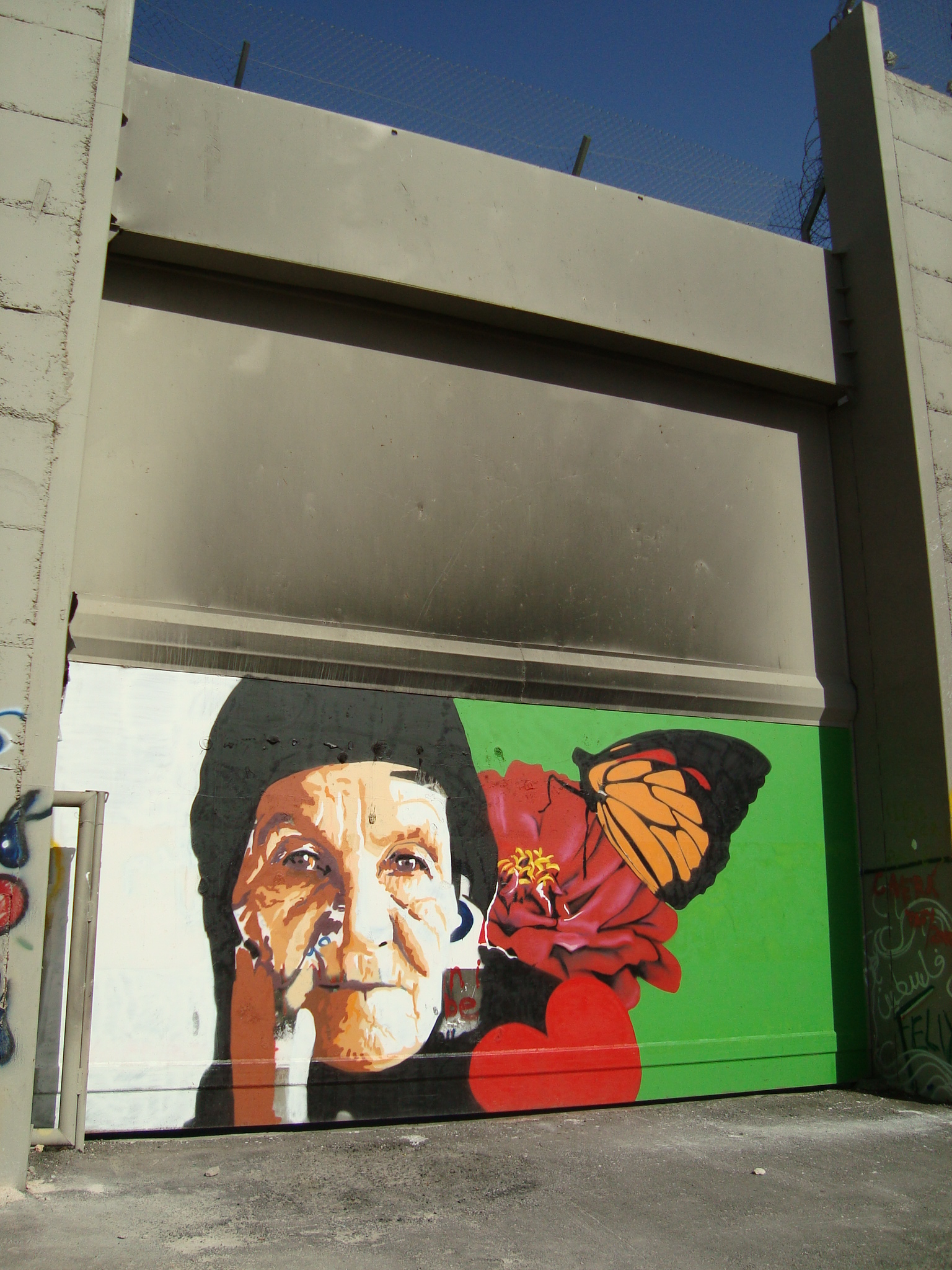
Visioning Peace.Wall Art on Bethlehem side of Israeli Separation Wall – 13 Jan. 2011 – Photo: Sherry Ann

Watching for news…advocating for a just peace

As the violence continues in Gaza and Israel, let’s not become immune to the horrific news… here are some on-line articles for sticking with this active vigil…

“Israelis Against the Bombing” by Symon Hill (here)

“My Visit to Gaza, the World’s Largest Open-Air Prison” by Noam Chomsky (here)

Independent Jewish Voices (IJV) in Canada – Media Release (15 Nov. 2012)  (here)

Edmontonian Paula Kirman speaks as a member of Independent Jewish Voices (17 Nov. 2012) – See the video here.

See this list from the Canadian Friends of Sabeel – “Stay informed on developments by following media sites which provide an honest picture and thoughtful analysis, such as:

** Please note that this is only a small compilation and not an exhaustive list.”

Action: Consider choosing not to purchase products made in illegal Israeli settlements in occupied Palestinian territories. This information has been prepared by the Interfaith Peace Initiative using information from WhoProfits.org (click here and here).

Action: If writing to the media, see this helpful webpage from the Canadian Friends of Sabeel (here).

Today the United Network for a Just Peace in Palestine and Israel, based in Canada, issued this statement in response to the violence in Gaza and Israel (click here for the UNJPPI website):

“[The UNJPPI] stands in solidarity with the people of Gaza who are facing an overwhelming military attack by Israel. The Israeli rockets and bombing in Gaza, while claiming to be strategically directed to military targets in Gaza, are killing many civilians as well as destroying essential non-military infrastructure. The tragic loss of lives of children is particularly heart-wrenching. The support of the US and other western powers, including Canada, for Israel’s action puts the onus unfairly on Hamas and the Palestinians for ending the violence. The Palestinian people have been living under the oppressive Israeli occupation of their lands since 1967. We believe that the Israeli occupation of Palestinian Land is the major contributor to the injustice that underlies the violence that has erupted in this conflict and that an end to the occupation is necessary for peace.

The devastating loss of lives on all sides is tragic. As friends of the Palestinians in Gaza as well as the West Bank, and in solidarity with our friends in the vibrant Israeli peace movement, we recognize the
frustration and desperation that they experience from living in what has been called “an open-air prison” created by the illegal Israeli occupation and blockade. We hear the pleas of Israelis who live in
fear in villages near the Gaza border for an end to the oppression that provokes the rocket attacks from Gaza. Our tears flow as we hear the cries of parents for the loss of their children. We call for an end to
the violence that is resulting in the tragic loss of civilian lives, including children and women.

We are concerned about the imbalance in the media reports. The international condemnation of the rocket attacks from Gaza and support for Israel’s right to defend its citizens is the predominant tone of many media reports. While we condemn the rocket attacks on Israel from Gaza, we are aware that the humanitarian situation of the population in the Gaza Strip is unbearable. Balance in media reporting and political analysis must recognize that life is precious, and loss from bombs or starvation, is equally tragic. In the words of an Ecumenical Accompanier currently in Palestine, “Are not the lives on the receiving end of the bombs in Gaza as precious as those on the receiving end of the rockets in Israel?” Peace requires restraint. We urge that both sides cease the attacks, but as Rabbi Arik Ascherman
(Rabbis for Human Rights) an Israeli Rabbi, notes, “With our greater power comes greater responsibility.”

With the people of Gaza, we have many questions. Our fear is magnified by the threat of Israel’s warning of increased retaliation and support from Western leaders. When will it end? When will the
international community stop justifying Israel’s right to protect itself at the expense of innocent civilians in illegally occupied territories? When will Canadians say, “Enough is enough?”

What can we do? Ecumenical Accompanier Dawn Waring quotes Palestinian author Sami Al Jundi who puts it poignantly: “My children will be safe only when your children know safety, and your children will be safe only when my children know safety … but actually there’s no such thing as my children and your
children. There’s only our children.” ~ And Dawn concludes: “Will you lend your voice to the cause of justice and peace ~ for all our children?”

In support for the action of the United Church’s General Council, we ask members to urge the Canadian government to provide leadership among nations advocating for the end of the Israeli blockade of Gaza
in order to facilitate a solution for peace with justice for all people in Israel and Palestine. May our prayers for peace join with the prayers of our friends in Palestine and Israel who are committed to
working in non-violent ways for a just peace even in this critical moment. May God’s Spirit of peace be over all.
November 16, 2012”

The Canadian Friends of Sabeel also offer this list of resources:

Compilation of articles, resources and analysis

With the attack on Gaza and the responses, in light of a lack of good mainstream media coverage, we have complied selective on-line resources in the hopes of providing an honest picture and thoughtful analysis.  These items below seem to offer perspective on the current situation.
Backgrounder on Gaza
The Gaza Strip: the Political Economy of De-development (2012 Edward Said Memorial Lecture) by Dr. Sarah Roy
This is an excellent piece and a must read! 
Contextualizing the U.S. approach to the region
The Petraeus Saga: Epitaph for a Four Star by Col. Douglas Macgregor, Ret.
http://www.counterpunch.org/2012/11/14/epitaph-for-a-four-star/print
Israel and the U.S.
Netanyahu calls Obama’s bluff by M K Bhadrakumar
The Invasion of Gaza: Part of a Broader US-NATO-Israel Military Agenda. Towards a Scenario of Military Escalation? By Michel Chossudovsky
Possible New CIA Director Already Politically Compromised:  Jane Harman and Israeli Spying by Alison Weir
Guardian: Obama’s kill list policy compels US support for Israeli attacks on Gaza by Glenn Greenwald
Timeline of events
TIMELINE: Israel’s Latest Escalation in Gaza by IMEU
Timeline of Israeli escalation in Gaza by Adam Horowitz
General
Interview with Ali Abunimah, a Palestinian American journalist, and co-founder of the Electronic Intifada
Inciting war crimes: Israel minister says force Gaza population into Egypt, cut off water, electricityby Ali Abunimah
G&M: Israel’s attack underlines helplessness, hopelessness of Gaza Palestinians by Diana Buttu
Israeli peace activist: Hamas leader Jabari killed amid talks on long-term truce by Nir Hasson
Opinion – Analysis
Nous accusons: Mainstream media fails to report on atrocities against Gaza by various (including Noam Chomsky)
Another Superfluous War by Uri Avnery
Who Started It? Bloodbath in Gaza by Patrick Higgins
Israel Looks To Exodus In Gaza Invasion by James Wall
Gaza-Israel Violence: The Fuller Story by Rabbi Arthur Waskow
Self-defense or provocation: Israel’s history of breaking ceasefires by IMEU
http://imeu.net/news/article0022250.shtml
A Pillar Built on Sand by John Mearsheimer (NECEF JGMLecturer – 2009)

Close to home…

Almost two years ago, I was placed for three months as an Ecumenical Accompanier (EA) with the Ecumenical Accompaniment Programme in Palestine and Israel (click here) in occupied East Jerusalem. Currently, my friend, Dawn, is nearing the end of a three-month placement in Bethlehem in the occupied West Bank (click here for her blog). Today, this news headline appears on Ma’an News‘ website:  “Rocket lands in settlement bloc near Jerusalem”. (For the article, click here.) Dove in Bethlehem.Artist: Banksy – 16 Dec. 2010 – Photo: Sherry Ann

Accompanying Palestinians and Israelis who seek a just peace means experiencing life under the Israeli government’s illegal occupation of the Palestinian territories: Gaza, the West Bank, and East Jerusalem. When I think about the current aggression in Gaza and southern Israel, it seems a bit removed; however, based on my and Dawn’s lived experiences, when I think about rocket fire near East Jerusalem and Bethlehem, the aggression feels much, much closer. We need to call, cry out for, an end to this occupation and the direct and indirect violence (click here). My friend, Sara, also an EA who was placed in Tulkarm in Fall 2010, has written:  “All violence against civilians, including rocket attacks from armed groups in Gaza, is strictly forbidden under international law.  However, virtually all international human rights organizations consider Israel’s blockade of Gaza to be a form of collective punishment—also forbidden under international law.  Without this being addressed there is really no hope [for] lasting peace.” Click here for her posting from 16 Nov. 2010.

One way to call for constructive action is to be present with local efforts across Canada. Click here for a list of gatherings near you; this list is provided by the Canadians for Justice and Peace in the Middle East (CJPME).

Following my last posting, I have received two encouraging messages from Canadian leaders. From the office of Elizabeth May, O.C., M.P., Member of Parliament for Saanich–Gulf Islands, Leader of the Green Party of Canada, I have learned that:  “Elizabeth May has issued a statement urging both sides to de-escalate the violence immediately, and work urgently toward a cease-fire agreement to prevent any more innocent lives from being lost. …it is equally important that we work to help ensure a meaningful and comprehensive peace process between Israelis and Palestinians.  In accordance with UN General Assembly Resolution 181 and UN Security Council Resolution 242, the Green Party supports statehood for Palestine, and recognizes that only once the systemic issues underpinning the present crisis are dealt with, will there be lasting and genuine peace  and security between Israel and Palestine.”

The office of Thomas Mulcair, M.P. (Outremont), Leader of the Official Opposition, New Democratic Party of Canada, pointed me to this press release (or click here) from 14 Nov. 2012: “Reaction to the Situation in the Middle East

New Democrats are very concerned by the recent escalation of tensions in Gaza and Israel. We call on all sides to exercise restraint and respect international humanitarian law obligations to protect civilians at all times.  Escalation would be dangerous and detrimental to prospects for long-term peace and stability in the region.  We are monitoring the situation closely and continue to call on the Canadian government to pursue a balanced and constructive approach in the Middle East.”

For news from the Physicians for Human Rights, click here.

For a reflection from Rabbi Arik Ascherman (I met him in 2011 in East Jerusalem) with Rabbis for Human Rights, click here.

For information from CJME, click here. Also, CJME offers this: “CJPME invites Canadians to click here to email their political leaders to ask them to call for an immediate ceasefire between Israel and Hamas. The link will take you through two steps – taking no more than 30 seconds – to ensure that your email is sent to your own MP [Member of Parliament], as well as the leaders and foreign affairs critics of each major political party in Canada.”