Standing for justice through nonviolent means.

This week members of the United Church of Canada are discerning how best to ‘stand’ for justice, in response to invitations from partner organizations within Canada and globally. As an Ecumenical Accompanier (EA) with the Ecumenical Accompaniment Programme in Palestine and Israel (EAPPI), I choose to stand in ways that are consistent with international humanitarian law and international human rights law. 

This slideshow requires JavaScript.

One way that Canadians, collectively, might stand for a just peace in Palestine and Israel is through the boycotting of products produced in illegal Israeli settlements in occupied Palestinian territories. All Israeli settlements in the occupied Palestinian territories are illegal according to Article 49 of the Fourth Geneva Convention, which states, “The Occupying Power shall not deport or transfer parts of its own civilian population into the territory it occupies.” The Israeli government is an occupying power and it is violating international law.

Engaged citizens can protest such violation through boycotting. Jean Zaru observes that, “Boycotts, divestment, and sanctions are nonviolent means for individuals, churches, academic institutions, cities, and corporations to make a difference and to highlight the need for adherence to international law and the rapid achievement of a just peace” (Zaru, 2008, p. 73). The United Church of Canada is considering an initial collective step through this boycott action of products produced in illegal Israeli settlements in occupied Palestinian territories. This would be a step that says, “no”, to economic structural violence.

“Structural violence is silent. It does not show. Television captures the direct violence and most often the violence of the powerless and the hopeless, and it is headlined as terror. One basic weakness in most conceptualizations of violence in the Israeli-Palestinian conflict is the basic assumption of symmetry, which views contending parties in conflict as being equal. After all, the conflict is there because we are unequal. We are unequal in access to power, media, and influence. But we insist that we are not unequal in our rights” (Zaru, 2008, p. 62). For additional information, click here.

Silent, economic structural violence (e.g., an unjust and unbalanced access to resources in occupied territories) is occurring in occupied East Jerusalem and the occupied West Bank. Through such violence, Palestinian society and Israeli society in Jerusalem are being torn apart. Ending this occupation and finding a just peace is critical for future co-existence.

Jean Zaru also offers this: “As Palestinians and as women our struggle to achieve these ideals [of justice, equality, and freedom] continues today. It has been a long struggle, waged on so many fronts. It has been a long walk, and a long road to freedom still lies ahead. On the way, we often get tired, confused, and frustrated; we sometimes lose direction; we find ourselves at an impasse or headed down a one-way or a no-entry or even a dead-end. But this has not discouraged us or made us give up our journey with others and for others. In fact, the difficulties of our journey have made the issues of the struggle even clearer and have revealed to us the interconnectedness of unjust structures, the web of oppression, and the various struggles for liberation” (Zaru, 2008, p. 105).

Reference: Zaru, Jean. (2008). Occupied with Nonviolence: A Palestinian Woman Speaks. Foreword by Rosemary Radford Ruether. Minneapolis, MN: Fortress Press. Click here.

Impassioned debate

Here is an update from today’s debate at the 41st General Council of the United Church of Canada. Click here and here.

See this commentary from last week (click here) from Stephen Scheinberg regarding the Centre for Israel and Jewish Affairs’ (CIJA) (which has succeeded the Canadian Jewish Congress) perspective on the United Church of Canada’s discussions.

For additional ecumenical activity on boycotting products from illegal Israeli settlements (i.e., Israeli settlements in the occupied Palestinian territories), see this international list (below). Thanks to the United Network for a Just Peace in Palestine and Israel (UNJPPI) for forwarding this info.

World Council of Churches – Voted in support of boycotting settlement products. Click here and here.

National Council of Churches in Australia – Voted in support of boycotting settlement products. Click here.

Presbyterian Church, USA – Voted in support of boycotting settlement products. Click here and here.

United Methodist Church, USA – Voted in support of boycotting settlement products. Click here.

Quakers, UK – Voted in support of boycotting settlement products. Click here.

Methodists, UK – Voted in support of boycotting settlement products. Click here.

Yes – Time to talk.

This week, the 41st General Council of the United Church of Canada is meeting in Ottawa, Ontario, Canada. On 14 Aug. 2012, commissioners debated a report of the Working Group on Israel/Palestine Policy in the United Church of Canada. The discussion is addressing the question of boycotting products from illegal Israeli settlements (i.e., Israeli settlements in occupied Palestinian territories). Discussion is not addressing divestment or the boycott of products from Israel. In the title for this posting, I paraphrase Bruce Gregersen, General Council Officer for Programs, who was reported to have said yesterday that “the report has prompted a widespread debate on the Palestinian situation”.

“This [three-hour debate] has opened up the conversation in the country. There are those who will say you should not have this conversation, that there’s no legitimacy to any conversation that would undertake any criticism of the legitimacy of the settlements,” he said.

“I think what we’ve done as a denomination is to say very directly that yes, it is appropriate to talk about this and we believe it’s vital to talk about this.” (Click here.) The 11-part motion will return to the floor for discussion today, 15 Aug. 2012.

A fellow Ecumenical Accompanier (EA) offered poems to we, Canadian EAs, yesterday, as we watch and wait. Thank you, Larry, for this “contemplative supplement” to the debate at General Council, readings of poems by a Palestinian living in Galilee, named Taha Muhammad Ali, and by Peter Cole: “The Place Itself, or I Hope You Can’t Digest It” and “Coexistence: A Lost and Almost Found Poem” (Click here).

In response, I offer this YouTube video by a sister EA from the Jerusalem Team that followed my team in Spring 2011. In response to my suggestion to ask the young Jahalin Bedouin teen girls about the meaning of “the sea” to them, two EAs invited the girls to dream about water and the sea. In this hope-filled video (click here), they discuss in Arabic and English their dreams as they write poetry.  See some of their finished poems here.

For recent updates regarding the Commissioners’ discussion, please click here and here.

Please click here for a response from Kairos Palestine (click here) members.

Please click here for a response from Independent Jewish Voices (IJV) Canada (click here).

For background information about the United Church of Canada’s Working Group report, click here. Scroll down to “Israel/Palestine Report”.

Finally, for information from the recently established United Network for Just Peace in Palestine and Israel (UNJPPI), click here.

Join us as we watch and wait. Talk about it within your own circles of friends, family, acquaintances, and new faces. Believe in a just peace for Palestine and Israel…and for our global home.

EAPPI Group 38 – occupied East Jerusalem – 19 Dec. 2010 – Photo: S. avMaat

Calling for accountability

Please see below the Urgent Action Appeal from the office of the Ecumenical Accompaniment Programme in Palestine & Israel (EAPPI) in occupied East Jerusalem. This appeal concerns Yanoun, one of the seven communities in which Ecumenical Accompaniers (EAs) are placed…to stand with those who seek to end Israel’s occupation of the West Bank, East Jerusalem, and Gaza – an occupation that is illegal according to international law.

A Canadian Ecumenical Accompanier (EA) is currently living in Yanoun. Click here to visit his blog. Consider “following” him by clicking on the “Follow” button at the lower-right corner of his blog. When I visited Yanoun in January 2011, the land spoke to my heart… and so I share some photos…

This slideshow requires JavaScript.

SUMMARY OF EVENTS:

On Saturday, 7 July 2012 at approximately 3:00PM (GMT+2) Israeli settlers from the illegal settlement of Itamar approached three Palestinian farmers in Yanoun who were harvesting their wheat and grazing their sheep. The settlers were armed with knives and killed three of the farmers’ sheep.

A clash then ensued, in which the settlers and farmers began throwing stones at one-another. When EAs arrived to the scene, three fires were ablaze in the fields, but it was unknown whether the flames were intentionally lit by the settlers or were started by tear gas canisters that the Israeli military fired at the farmers. Nonetheless, two wheat fields and one olive grove were burnt, and when other Palestinian farmers arrived at the scene to turn out the flames, Israeli soldiers and police prevented them from reaching the fields by firing more tear gas at them.

In total six Palestinians were injured, and five were hospitalized:

  • Jawdat Bani Jaber (Hospitalized): was beaten and stabbed multiple times by settlers, then shot in the face and foot by Israeli soldiers. He was then handcuffed by Israeli soldiers and attacked again by the settlers while the soldiers pursued other Palestinian farmers. After being attacked, the military did not allow a present ambulance take him to a hospital or care for him for approximately 3-hours.
  • Ibrahim Bani Jaber (Hospitalized): was beaten by a soldier on his head with the butt-stock of an M16 rifle, causing damage to his eye, and was later beaten by settlers while handcuffed.
  • Hakimun Bani Jaber (Hospitalized): was shot in the arm at close range by a soldier.
  • Adwan Bani Jaber (Hospitalized): was beaten by settlers with clubs.
  • Ashraf Bani Jaber: was beaten by a soldier with a club.
  • Jawdat Ibrahim (Hospitalized): was handcuffed, beaten by Israeli soldiers and then released for the settlers to attack as they watched. He was then tied up by the settlers and left on his land; he was found the next morning (Sunday, 8 July 2012).

Rashid, Mayor of Yanoun and long-time EAPPI local contact, expressed fear that settlers initiated the clash to enforce new invisible boundaries, which would defacto confiscate much of the area’s wheat fields to the Itamar Settlement.

ADDITTIONAL INFORMATION:

Yanoun is a small village in Area C of the West Bank, just southeast ofNablus. It has about 65 inhabitants who are dependent upon farming and animal husbandry as their main source of livelihood. The village is surrounded by the illegal Israeli settlement of Itamar and since 1996 the residents of Yanoun have consistently experienced settler harassment and violence, as well as property damage and confiscation.

In October of 2002 the settlers of Itamar forcibly evacuated Yanoun of its inhabitants. International humanitarian agencies and Israeli human rights organizations then came to Yanoun to provide a protective presence with the aim of facilitating the return of the community. These left Yanoun within weeks of the community’s return; however, the Ecumenical Accompaniment Programme in Palestine and Israel (EAPPI) has remained in Yanoun since October 2002. Based in Yanoun, Ecumenical Accompaniers (EAs) provide a protective presence, monitor, and report on human rights violations in the community, as well as the entire Nablus Governorate and Jordan Valley.

INTERNATIONAL HUMANITARIAN LAW:

The International Court of Justice has stated that the 1949 Fourth Geneva Convention for the Protection of Civilian persons in Times of War applies to the occupied Palestinian territory.

All Israeli settlements are illegal according to Article 49 the Fourth Geneva Convention, which states, “The Occupying Power shall not deport or transfer parts of its own civilian population into the territory it occupies.

Article 4 
of the Fourth Geneva Convention states, “Persons protected by the Convention are those who, at a given moment and in any manner whatsoever, find themselves, in case of a conflict or occupation, in the hands of a Party to the conflict or Occupying Power of which they are not nationals.” Thus, according to International Humanitarian Law,Israel has the duty as an occupying power to protect Palestinians from settler attacks.

MAKE A DIFFERENCE:

We encourage you to:

  • Forward this email to your networks.
  • Inform your representative in parliament about what has happened in Yanoun.
  • Update news/media agencies (radio, TV & print) in your countries about this incident.
  • Contact (Preferably fax) the following officials and call on them to condemn this attack and hold Israeli settlers accountable for the human rights violations that they commit against Palestinian civilians:

o   Your Ambassador and/or Consul General inIsrael (click here)

o   The Israeli Ambassador in your country (click here)

You may use the sample letter below or draft your own:

Dear Ambassador / Consul General / Minister / Judge Advocate General / Lieutenant-General,

I call upon you to condemn Israeli settler violence against Palestinian civilians and to call for all those who violate human rights in the oPt to be held legally accountable for their actions.

On Saturday, 7 July 2012 at approximately 3:00PM (GMT+2) Israeli settlers from the illegal settlement of Itamar approached three Palestinian farmers in Yanoun who were harvesting their wheat and grazing their sheep. The settlers were armed with knives and killed three of the farmers’ sheep.

A clash then ensued, in which the settlers and farmers began throwing stones at one-another. Israeli soldiers and police arrived to the scene only to support the settlers’ attack on a defenseless community.

In total six Palestinians were injured, and five were hospitalized:

  • Jawdat Bani Jaber (Hospitalized): was beaten and stabbed multiple times by settlers, then shot in the face and foot by Israeli soldiers. He was then handcuffed by Israeli soldiers and attacked again by the settlers while the soldiers pursued other Palestinian farmers. After being attacked, the military did not allow a present ambulance take him to a hospital or care for him for approximately 3-hours.
  • Ibrahim Bani Jaber (Hospitalized): was beaten by a soldier on his head with the butt-stock of an M16 rifle, causing damage to his eye, and was later beaten by settlers while handcuffed.
  • Hakimun Bani Jaber (Hospitalized): was shot in the arm at close range by a soldier.
  • Adwan Bani Jaber (Hospitalized): was beaten by settlers with clubs.
  • Ashraf Bani Jaber: was beaten by a soldier with a club.
  • Jawdat Ibrahim (Hospitalized): was handcuffed, beaten by Israeli soldiers and then released for the settlers to attack as they watched. He was then tied up by the settlers and left on his land; he was found the next morning (Sunday, 8 July 2012).

Though the settlers were the attackers in this clash, the Israeli Military and Police provided them with protection to carry out the attack. The soldiers and officers attacked Palestinians who defended themselves from the settlers, did not attempt to put out the fires that blazed through Palestinians’ fields – nor let anyone else do so, and delayed medical attention for the victims of the attack.

Like the many Israeli settler attacks that take place on an on-going basis across the occupied Palestinian territory, no Israeli settlers were arrested during this attack.

Sincerely,

YOUR NAME

Invitation to participate

I invite you to write a Letter to the Editor of The Globe and Mail to encourage the editorial team to interview the authors of the report of the Working Group on Israel/Palestine Policy in the United Church of Canada, the accompanying You Tube commentary, additional comment, and ‘question and answer’ document. I encourage you to ask the editorial team to report on the Working Group’s response, in The Globe and Mail, much as the newspaper reported yesterday (click here): “Canadian senators warn UnitedChurchover Israelboycott”.

Click here to read two letters issued by The United Church of Canada.

For a very helpful contribution to the national discourse written by a member of our ministry team at Southminster-Steinhauer United Church, Rev. Dr. Nancy L. Steeves, click here.

For some background on the Canadian senators’ letter, click here to listen to the exchange on CBC’s As It Happens in early June.

Here is the email address for the editorial team at The Globe and Mail: letters@globeandmail.ca 

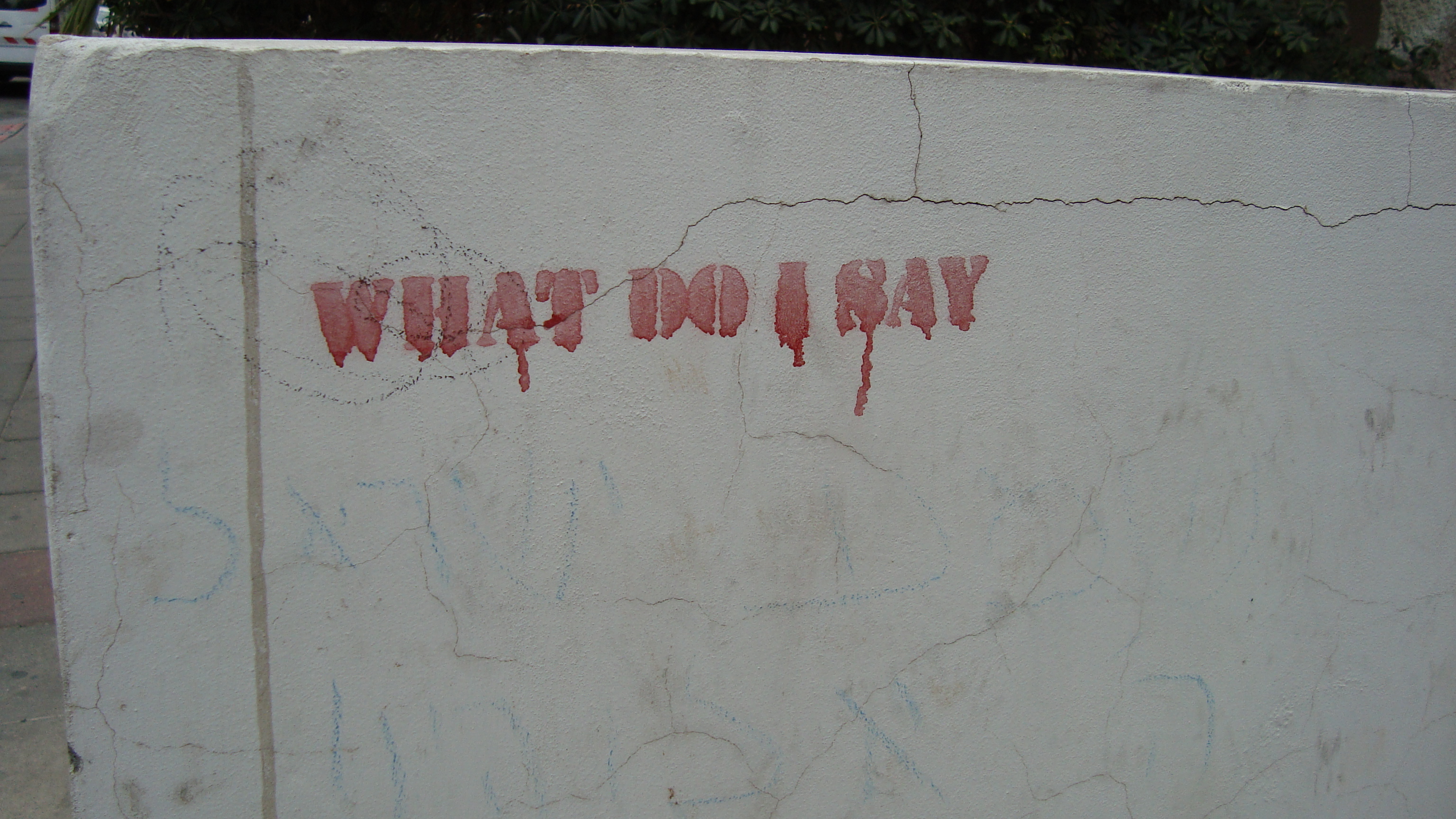
Invitation on a garden wall. Tel Aviv - 29 Dec. 2010 - Photo: Sherry Ann

Invitation on a garden wall. Tel Aviv – 29 Dec. 2010 – Photo: Sherry Ann

Standing with Palestinians who live in Area C

Dear All,

One in my Ecumenical Accompanier circle (click here) has shared this news with me today:

“Rabbis for Human Rights is calling for people to go to Susiya.  Since we cannot jump up and go, let our actions of support fill the West Bank with the spirit of indignation, solidarity and hope for justice….

A new Post “Join the protest Vigil: No to the Demolition of Susya” was written on the June 17, 2012 at 3:25 pm on “Rabbis for Human Rights”.

Israeli army forces threaten to demolish the entire Palestinian village of Susya.
This week, demolition orders for approximately fifty dwelling structures were handed out, which add to numerous additional orders issued recently. In addition, the Civil Administration has announced the residents of Susya that it intends to implement six demolition orders issued in the 1990s and 2001. From past experience, such notices are only given when there is genuine intention to go through with demolitions. **The demolition orders cover the most of Palestinian Susya. Not only dwelling structures but also animal pens, water cisterns, the solar-powered electricity system – everything.
Unlike Givat HaUlpana, This is not a case of building on lands privately owned by others. The rights of Susya’s Palestinian residents over the land in which they reside has been legally demonstrated and acknowledged by the Israeli authorities. The occupation authorities deliberately refrain from approving a master plan for Susya in order to deny its residents (like those of many Palestinian villages in area C) any possibility to build in a manner the Israeli authorities will consider legal.
Unlike the settlers form Givat HaUlpana, no one will offer the residents of Susya any reimbursement. They will receive no alternative housing. No one will speak of a housing arrangement of the interim period. Netanyahu will not offer to relocate their homes.
After their village will be demolished, the residents of Palestinian Susya will simply be tossed into the desert, and not for the first time. Since the establishment of the nearby Israeli settlement of Susya, the residents of Palestinian Susya were evicted from their lands four times.
On Friday, June 22 we will stand side by side with the residents of Palestinian Susya in a protest and support vigil and will call:
No to the fifth demolition of Susya!
No to the throwing of people from their homes and tents!
No to the silent transfer of the Palestinian population out of area C!”

Another Ecumenical Accompanier friend wrote this about Susiya, not so long ago. I shared news about this part of the occupied West Bank on this blog on 13 Jan. 2011 and 23 Dec. 2011. Read more here.

What do we do? Learn more and take a stand. The Working Group on Israel/Palestine Policy in the United Church of Canada has been doing just that. I met with them in East Jerusalem in Winter 2011. They have produced a report, offered You Tube commentary, and continue to comment. See this ‘question and answer’ document.

Choose one action to take. Perhaps, it’s a matter of forwarding this posting to someone in your circle. Perhaps, it’s a letter to your MP. Perhaps, it’s each of us gathering together to demonstrate that we believe that a just peace is possible…

Looking southeast into Area C, from Jahalin Bedouin community - 2Feb2011 - Photo: S.Nelson

Looking southeast into Area C, from Jahalin Bedouin community – 2Feb2011 – Photo: S.Nelson

Palestinian Christian voices

Following my postings of 23 April and 26 March 2012, I offer additional resources regarding the call of Palestinian Christians for a just peace through faith, hope, and love. Click here for their document, Kairos Palestine, comparable to the Kairos document published by black South African theologians in 1985 regarding South African Apartheid.

Learn about Palestinian Christians, in their own voices, in the recent publication from EAPPI. Click here and then click on the hyperlinked title, “Faith Under Occupation” (the second listing of the title): “In this EAPPI study, they tell their own story of life under an occupation that discriminates against all Palestinians, regardless of their faith.”

Christian Quarter - Old City - Jerusalem - 13 Feb 2011 - Photo: Sherry Ann

Christian Quarter - Old City - Jerusalem - 13 Feb 2011 - Photo: Sherry Ann

Robert Wright, a senior editor at The Atlantic, has offered an editorial regarding the 60 Minutes segment. For Wright’s editorial, click here. To watch the segment, click here and you’ll be taken to the 60 Minutes website where you can watch the clip.

For a recent commentary in Ha’aretz, click here.

Mairav Zonszein, an Israeli-American native of New York City, living in Israel since 1999, offers her commentary here.

Read +972’s piece by Yossi Gurwitz here.

One response to this issue in the media is to consider signing a petition (click here) organized by Jewish Voice for Peace, an American, grassroots organization dedicated to promoting equality, democracy and self-determination for both Israelis and Palestinians. For comparable activity in Canada, click here for Independent Jewish Voices (IJV) Canada.

Insight into stories told about Palestinian Christians

The following message arrived in my Inbox today from the Canadian Friends of Sabeel. I highly recommend their invitation to watch the 14-minute clip from yesterday’s 60 Minutes television program. Simply click here and you’ll be taken to the 60 Minuteswebsite where you can watch the clip.

“The television News Magazine 60 Minutes on CBS aired this segment, on April 22, on the exodus of Palestinian Christians from the Holy Land. It highlights the Kairos Palestine document of the Palestinian Christian churches.

Nora Carmi, who works for Kairos Palestine, is coming to Canada next month on a speaking tour. The document is behind some of the efforts of American and Canadian churches working towards BDS (Boycott, Divestment, Sanctions) because of the illegal occupation partly described in the 60 minutes piece.

To view the 60 Minutes segment, please click here.”

For some additional commentary, click here.

Rev. Dr. Naim Ateek - Sabeel, Jerusalem - 23 Dec. 2010 - Photo: J. Graham

As a reminder, I had the privilege of meeting Rev. Dr. Naim Ateek who founded Sabeel in 1990. See my posting on 25 Dec. 2012. Sabeel is “an ecumenical grassroots center for liberation theology among Palestinian Christians, that seeks to promote peace with justice in the Middle East. The Sabeel center is in Jerusalem. It was founded following an international conference in March 1990, which placed Palestinian liberation theology in relationship to other liberation theologies from around the world. (See Faith & the Intifada, edited by N. Ateek. M. Ellis, and R. Ruether, 1992).”

“Land Day” – Canada Park – not in my name…

“What message are Canadians giving when our nation’s name is linked to the expulsion of a people from their land and paid for with Canadian tax-deductible dollars that has been used – in contravention of international law – to effectively annex a section of the West Bank to Israel? …

As we Canadians prepare for our annual spring ritual of filing our taxes, it is time to renounce our namesake park.” -Corey Levine (31 March 2011) (For the full article, click here.)

"Canada Park" - On the road to Jerusalem from Tel Aviv - 26 Jan. 2011 - Photo: Sherry Ann

“As spring sets in early, Israelis have been pouring into one of the country’s most popular leisure spots. Visitors to Canada Park, a few kilometers northwest of Jerusalem, enjoy its spectacular panoramas, woodland paths, mountain-bike trails, caves and idyllic picnic areas.

A series of signs describe the historical significance of the landscape, as well as that of a handful of ancient buildings, in terms of their Biblical, Roman, Hellenic and Ottoman pasts. Few, if any, visitors take notice of the stone blocks that litter sections of the park.

But Eitan Bronstein, director of Zochrot (Remembering), is committed to educating Israelis and foreign visitors about the park’s hidden past — its Palestinian history.

“In fact, though you would never realize it, none of this park is even in Israel,” he told a group of 40 Italians on a guided tour this past weekend. “This is part of the West Bank captured by Israel during the 1967 war. But the presence of Palestinians here — and their expulsion — is entirely missing from the signs.” ” – Jonathan Cook (2009) (For the full article, click here.)            ~~~~~~~~~~

“As North Americans, we support the “Global March to Jerusalem” (click here and here) on March 30, 2012. The March is initiated and will be directed by Palestinians from around the world. The Global March to Jerusalem will reassert and affirm the Palestinian refugees’ Right of Return and right of access to Jerusalem.

The organizers, endorsers and participants have committed themselves to a nonviolent march and have no intention to harm any person. We encourage other individuals and organizations that are committed to human rights and justice to support the Global March to Jerusalem: participate as marchers; volunteer services to the project; take legal, official and diplomatic intervention on behalf of the refugees; and, offer financial support.” (See more here.)           ~~~~~~~~~~

“Why Land Day still matters

Today, with no resolution in sight to the historic injustices inflicted upon
them, Palestinians in Israel and elsewhere use this day to remember and
redouble their efforts for emancipation.

By Sam Bahour and Fida Jiryis

Every year since 1976, on March 30, Palestinians around the world have
commemorated Land Day. Though it may sound like an environmental
celebration, Land Day marks a bloody day in Israel when security forces
gunned down six Palestinians, as they protested Israeli expropriation of
Arab-owned land in the country’s north to build Jewish-only settlements.

The Land Day victims were not Palestinians from the occupied territories,
but citizens of the state, a group that now numbers over 1.6 million people,
or 20.5 percent of the population. They are inferior citizens in a state
that defines itself as Jewish and democratic, but in reality is neither.” (For the full article, click here.)          ~~~~~~~~~

See an article from The Globe and Mail (30 March 2012) (click here) and follow that article to the Comments section (here).          ~~~~~~~~~

As a Canadian, I am embarrassed that a place (that is part of the story of the expulsion of Palestinians) in the occupied West Bank would be named Canada Park. I am moved to think about Canada’s own colonial history. I choose to listen and learn and join the global movement for justice for all…  As one step into this journey, I will be listening to the four-part video at this site – click here. Another step is to learn more about the Truth and Reconciliation Commission of Canada – click here.

“Palestinian Christians…the Palestinian embroidery…” Jean Zaru

Plain and simple. Christians are indigenous to Palestine yet they’re leaving due to economic and political instability and the loss of freedom of movement as a result of the Israeli government’s occupation of Palestine. Not due to Palestinian Muslims. Yet, so many news headlines in the past week suggest that Muslims are to blame for so much…and that promotes Islamophobia. See Amira Hass’ article. Also, see today’s article by Karen Armstrong in The Globe and Mail.

“Palestinian Christians are referred to as the Palestinian embroidery – an interwoven and an integral part of the whole population.” –Jean Zaru

Jean Zaru is the Presiding Clerk of the Friends Meeting House in Ramallah and a founding member of Sabeel, the ecumenical Palestine Liberation Theology Center in Jerusalem. I highly recommend her book: Zaru, Jean. (2008). Occupied with nonviolence: A Palestinian woman speaks. Foreword by Rosemary Radford Ruether. Minneapolis, MN: Fortress Press. Click here for info.

I also invite you to learn more about Palestinian Christians in the recent publication from EAPPI. Click here and then click on the hyperlinked title, “Faith Under Occupation” (the second listing of the title).      **See page 46 for the section that I wrote with my EAPPI team-mate. We had the opportunity to ask a number of Palestinian Christians for their perspectives.

For interest, why not check out the Charter for Compassion (click here), a civil-society movement facilitated by Karen Armstrong. By visiting the Charter’s website, I found the link to the above-mentioned Globe and Mail article by Karen Armstrong.

Plain and simple. We, as Canadians, have an opportunity to live up to our obligations to uphold respect for international human rights and humanitarian law (See Federal Election Kit, 2011, The United Church of Canada, p. 20).  Let’s be compassionate…Canada.

"Canada" - a cushion for kneeling in prayer - St. George's Cathedral, occupied East Jerusalem - 23 Jan. 2011 - Photo: Sherry Ann


“The Cathedral is home today to two congregations: the indigenous Palestinian Anglicans, often called the ‘Living Stones,’ and a community of expatriate English speaking members.

The local Arabic speaking Anglicans are part of the historic Christian presence here since the time of the first Pentecost:

‘Cretans and Arabs – in our own language we hear them speaking about God’s deeds of power’Acts 2:11

The Cathedral remains a focal point for theProvinceofJerusalemand theMiddle Eastand the Worldwide Anglican Communion.” (Click here for more info.)