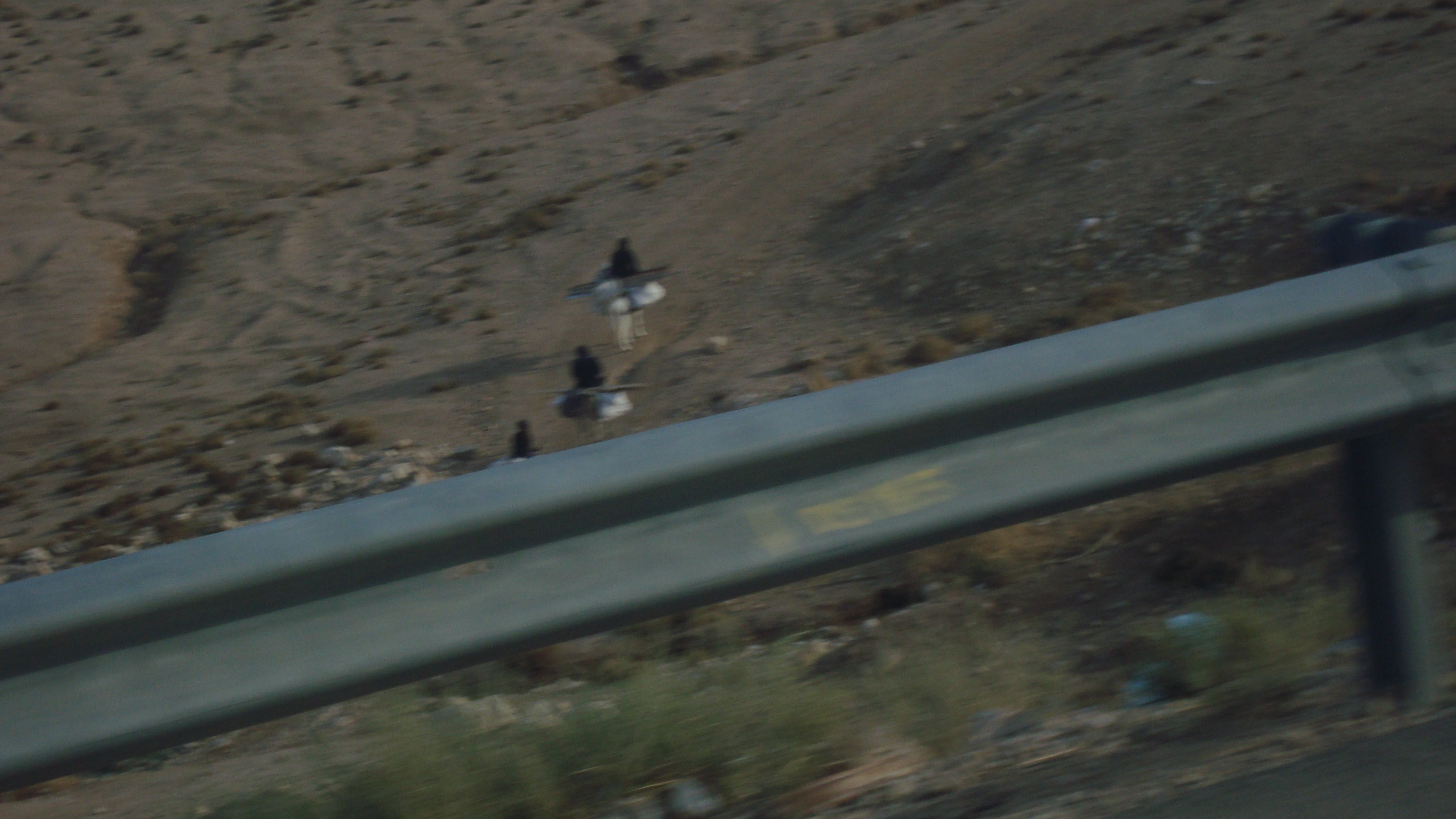
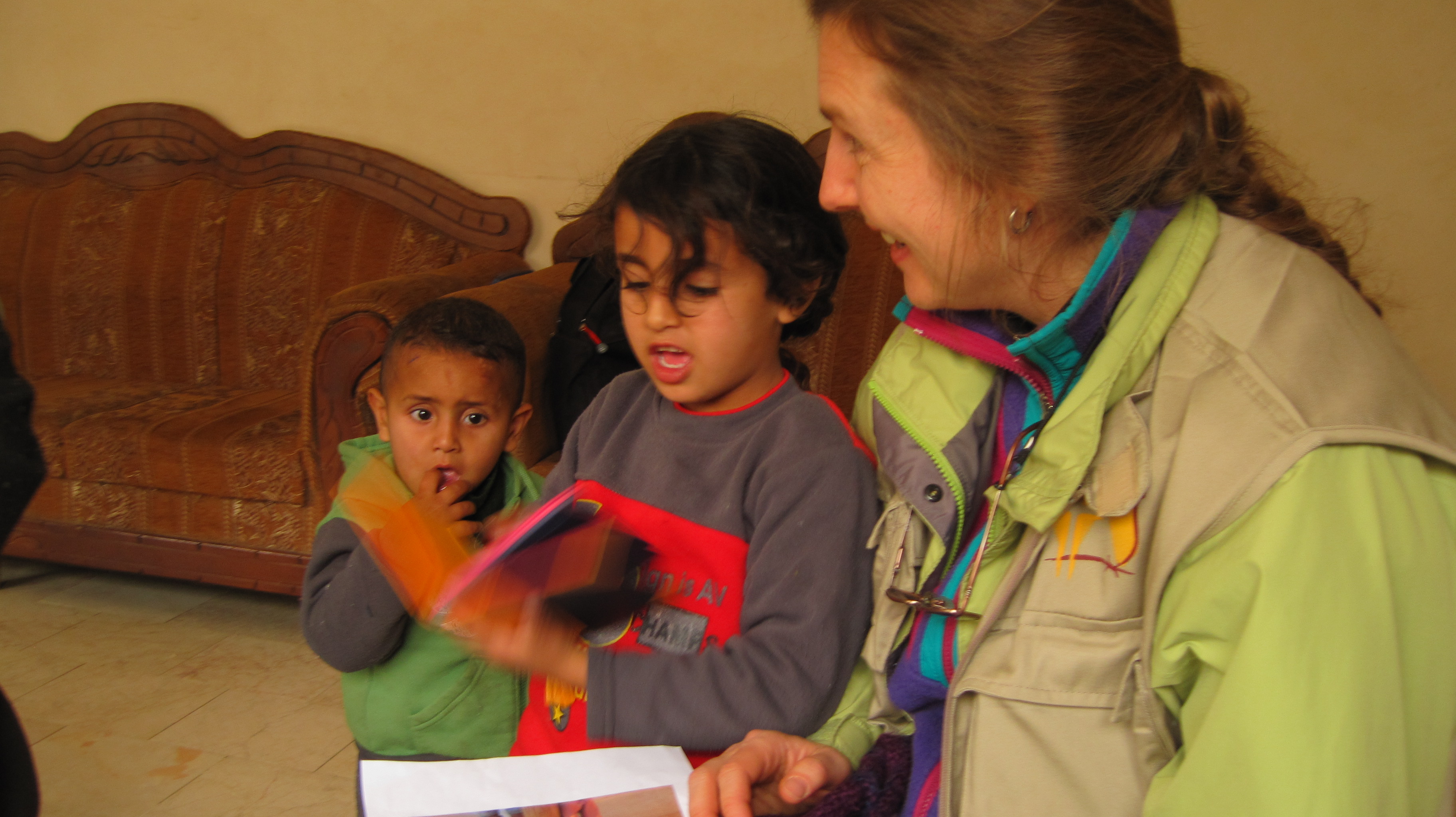
“The choice of sounds to go down in Palestinian cultural history as the first ever played by the orchestra attests to the polyphony expressed in this concert: the immediate, clear voice, which calls for revival, independence and freedom; and the hidden, interior one, which sends a message of brotherhood to the society from which liberation is needed, Israeli society, in the form of conceding the tragic refugee history of that society. We are refugees without a country; you were such just half a century ago − we are brothers, the piece seems to say. … . See, it is possible. The music managed to get through the checkpoints and the walls as though they never existed.” (From Haaretz, by Noam Ben Zeev, 14 Jan. 2011)
Demolition: South Hebron Hills
The following report and photos were prepared by members of the Ecumenical Accompaniment Team in Hebron, 12 Jan. 2011.
Israeli army demolishes seventeen structures in village near Hebron
“On the morning of January 12, children of Dkaika were in school and the families were going through their morning routines. Suddenly, the army appeared and the demolitions began,” reported international accompaniers from EAPPI.
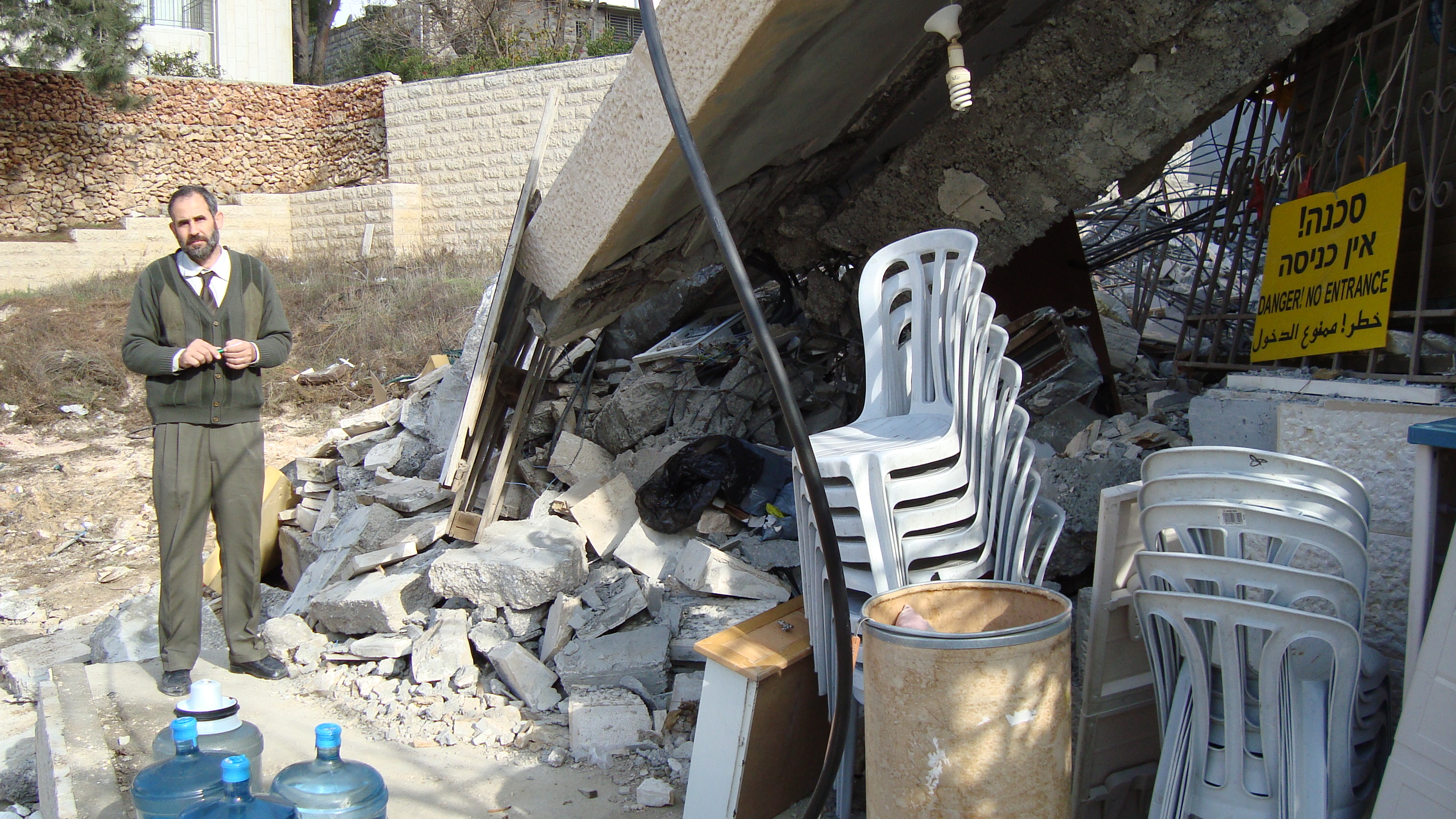
Seven households (residential structures) destroyed; 1 animal shelter; and 1 class room. In total 46 people were displaced plus an additional 10 students (not displaced, but have lost their classroom).
The accompaniers’ journey yesterday to Dkaika was delayed by military checkpoints. When they arrived, 17 structures in the village had already been destroyed. They reported that there were four bulldozers present, along with Israeli military civil administration officials and guarded by up to one hundred soldiers.
One of the village women, Hamdah Najadah, told accompaniers: “Two policewoman stopped me when I wanted to go in to the house and take out the furniture and our things before they demolished it. They would not let me,” she told them.
“They destroyed everything, even the coffee, sugar and flour. Where will we sleep? It is winter, and bad weather is coming. God be with us!”
There are around 39 families in Dkaika village. Nasser Najadah (see photo) is 73 years old and was born in the village. His family lost 7 buildings, including the one where they sleep. Three villagers, among them two teachers, were arrested.
The homes that were demolished yesterday were homes that were not covered by the restraining orders. The 4th Geneva Convention states that “any destruction by the Occupying Power of real or personal property… is prohibited, except where such destruction is rendered absolutely necessary by military operations.” (Article 53). No notification was given to the villagers as to when the demolitions would happen.
Many other houses in the village have demolition orders from the Israeli courts, says the Israeli human rights group Rabbis for Human Rights. The group has been attempting to get a master plan for Dkaika approved by the Israeli courts. Some houses are temporarily protected from demolition pending a court decision on the plan.
“When the hearing on the zoning plan happens, the decision will not be made simply on planning criteria, but political criteria will be involved so it’s hard to be optimistic,” Rabbi Arik Ascherman, General Secretary of Rabbis for Human Rights.
The Red Cross provided tents for the villagers who lost their homes yesterday.”
Sherry Ann’s additional note: See this article about a separate demolition in the West Bank on 11 Jan. 2011.
The Ecumenical Accompaniment Programme in Palestine and Israel (EAPPI) brings internationals to the West Bank to experience life under occupation. Ecumenical Accompaniers (EAs) provide protective presence to vulnerable communities, monitor and report human rights abuses and support Palestinians and Israelis working together for peace. When they return home, EAs campaign for a just and peaceful resolution to the Israeli/Palestinian conflict through an end to the occupation, respect for international law and implementation of UN resolutions.
“Ask the citizens of Jerusalem to control Jerusalem.”
Here is the story of one part of one family of Sheikh Jarrah…
Bassem Sabbagh and I met on 7 January 2011at a demonstration in Sheikh Jarrah, a neighbourhood in occupied East Jerusalem. He lives with his family in Sheikh Jarrah. The name, Sheikh Jarrah, comes from the name of the doctor that accompanied Salah al-Din in the twelfth-century capture of Jerusalem. This neighbourhood is on the occupied, east side of the Green Line, the 1949 Armistice line following the declaration of the state of Israel and the Arab-Israeli War. This is known as the War of Independence ( העצמאות, Milhemet HaAtzma’ut) in Israel and as the Nakba or Catastrophe ( النكبة, al-Nakba) by Palestinians.
Bassem grew up in his Sheikh Jarrah home. He has four brothers, Mohammad, Osama, Bassam, and Ghaleb. In 1980, Bassem moved to Bahrain for work, having completed his education in 1979. He had both a Jordanian passport and a Jerusalem ID card. However, in 1996, the Israeli government canceled his Jerusalem ID claiming that he had spent more than seven years living abroad, despite Bassem’s time spent every year with his family in Sheikh Jarrah. At that point, Bassem was forced to decide between leaving Jerusalem forever or returning to live full time in Jerusalem. He chose to stay in Jerusalem. Bassem asked his wife to fly to Bahrain in order to resign on his behalf; she, too, resigned from her position. They had to sell their assets in Bahrain thus losing their savings; they settled in Jerusalem to start their lives again. For four years, Bassem did not have any identity papers. He worked in Ramallah (north of East Jerusalem) and could never be sure if he would be arrested for crossing between East Jerusalem and the West Bank. At times, he wished that he would be caught and then sent abroad rather than live in this uncertain way.
In 2000, after much effort in navigating the Israeli court systems, Bassem and all of his family members were given their Jerusalem ID papers.
Yet, not long after this ID-card issue was settled, another issue arose for Bassem’s family. The ongoing process of dispossessing and evicting 17 of the original 28 Sheikh Jarrah families began to affect the Sabbagh family. (For an overview of the shattering process leading to evictions of 60 Palestinians including 24 children, see UNOCHA’s Oct. 2010 fact sheet).
The five parts of the extended Sabbagh family (as led by the five brothers, Mohammad, Osama, Bassem, Bassam, and Ghaleb) continued to live in Sheikh Jarrah. In 2009, they “received court papers indicating the intention of Nahalat Shimon International [a well-funded, Israeli settler organization] to assert their claim over the land” (see report , p. 17; also see pp. 25-26; p. 12, p. 39) Mohammad, Bassem’s brother, has stated, “This case is very important for the neighbourhood. Because it is new it will allow us to introduce new documents which refute the ownership claims of Nahalat Shimon International” (p. 26). In the cases with the 17 other families, the Sephardic Community Committee and the Knesset Israel Committee have sought to discredit the families’ ownership of the properties. What is critical in the Sabbagh case is that the Committees, in backing Nahalat Shimon International, have been asked to demonstrate their prior ownership (from 1886 – see report, p. 11) of the land. To date, the Committees have been unable to demonstrate this ownership claim for the court.
Bassem has visited the Sabbagh family home in Jaffa. He and his brother, Mohammad, have spoken with the people that have lived there since buying the property from the Israeli government, after 1948.
On 7 January 2011, I asked Bassem for his thoughts about occupied East Jerusalem. He offered the following:
“Democracy in Israel is false. Israelis have the right to get their property back [e.g., property owned prior to 1948]…, while we…are not allowed to do so. Once I spoke to an Israeli about this issue, his answer was “What was in the past is passed” but this is not applicable to them.
Their mentality is odd; they still live in the past. The world has changed but they aren’t changing. Most of the time, they feel they are threatened by unknown powers… . They have created these feelings to control others. They teach their sons how to hate, how to dominate….They are poor by living inside the illusion of fear.”
I asked Bassem for his thoughts on the future of Jerusalem. He said that Jerusalem is the “final obstacle”, “the most difficult issue” preventing a resolution to the Israeli-Palestinian conflict. (See report, p. 50)
From his perspective, Bassem hopes that, in the future, Jerusalem would be:
“Open for everybody, to be allowed to enter, pray, and visit the holy places. Not just for Israelis, Palestinians, or Jordanians. They all have holy places.”
“No one will accept others’ control of Jerusalem; it’s a place of conflict.”
Bassem considers himself a realist and an optimist.
“Everyone wants peace but what kind of peace? My peace is not like your peace.”
I asked, if he were to dream, what would be ideal?
In response, he asked, “Ideal for Jerusalem or for Palestine? They’re different. What would be ideal for Palestine? Well, after10, no 5 years, you would drive into the occupied West Bank and it would be one of the most developed countries in the Middle East. Already, people are building for the future with streets, industry, culture, sports, music, and more.”
I asked what would be ideal for Jerusalem.
“Jerusalem should be open to everyone. People would be free to come and go. If Israel were smart, Israel would open Jerusalem to everyone and they would make a fortune. Given that Muslims are required to visit not only Mecca but also Jerusalem, three to four million people would visit Jerusalem annually, in addition to the Christians and Jews, from all the world. That would boost hotels, markets, and business. Instead, Israel is asking for security. The culture of Israel has to change. No one is interested anymore in ‘throwing Israel into the sea’. That’s in the past. People just want to build. This is real, not an image. No one is interested in fighting now. That kind of intifada is a thing of the past. Right now, a different kind of intifada is occurring: building. Israel has been doing that [building] since 1948. Abu Mazzen is no longer able to engage Netanyahu in dialogue; that coalition government is not able to sustain dialogue. Instead, Abu Mazzen is approaching directly the streets of Israel, addressing the people. Peace requires courage and the Government of Israel lacks leaders who have the courage to go into the peace process. When you seek peace, you have to abandon part of your dreams and part of your history.”
I asked Bassem about his statement, “No one will accept others’ control of Jerusalem; it’s a place of conflict”. What would he envision? Shared control?
“Ask the citizens of Jerusalem to control Jerusalem.”
Home demolition – What happens then…?
Further to my posting of 1 Jan. 2011 and the reference to home demolitions in East Jerusalem, our EAPPI Team in Jerusalem accompanied a family whose home was demolished on 3 Jan. 2011. Nasser and Lina Seyam and their six children were left with one “legal” room in which to live. See these two online news articles for photos and more info: “Palestinian property demolished in French Hill” and “Israeli authorities on Monday demolished part of a Palestinian home in occupied East Jerusalem”.
On the morning after the demolition, two of our team returned to check on the family.
Day after: “How are you?”
Blank yet deepest wells for eyes:
Slight shrug. “We’re trying to move forward.”
As we left, the family was expecting a visit from the International Committee of the Red Cross (ICRC). We think that the United Nations Office for the Coordination of Humanitarian Affairs (UNOCHA) may visit, too. What then…
Drawn by hope…into 2011
Through this past week, I was lucky to have a few days off. This meant that when two alerts came in from the Displacement Working Group (DWG), my team mates responded while I was away. We are finding our way as a team, with members coming and going on placements and days off.
When I arrived in Tel Aviv for my break, I was thankful to sit on a rocky wharf by the beach to meditate on the sight and sound of the Mediterranean Sea…to try to make sense of the intensity, particularly of the home demolitions, of the past week and a half…and of the inhumane checkpoints…and of wide ranging degrees of optimism that we are hearing from Palestinian and Israeli people who stand against the occupation…
On Tues., 28 Dec. 2010, we attended an Alternative Information Centre evening with Israeli journalist, Gideon Levy. I heard him speak in Edmonton earlier this year about his new book, The Punishment of Gaza. This time, he spoke on the role of the Israeli media in the Occupation. His perspective, which he admits, is rather bleak, for example:
“The Occupation is totally not on the Israeli agenda.”
“No one in Israel wants to tell or wants to know this story [about the Occupation].”
“The Israeli media shapes those concepts [the lack of attention about the Occupation and what is covered, is covered “in a very twisted way”].”
“The only effective, active group in Israeli society is the settlers.”
“The Israeli Left collapsed totally and dramatically ten years ago… . In the Oslo years, there was no price to pay for speaking about peace… .” He did acknowledge the ongoing courageous efforts of Breaking the Silence, B’Tselem, Physicians for Human Rights, and Machsom Watch. Note: EAPPI has contact with these groups, standing with them toward a just peace.
Levy reflected on how he perceives the Palestinians and their “basic sentiment, to live together [with Israelis] as two peoples”. He also appears troubled by what he sees as Israelis’ approach: “Let’s separate so that they [Palestinians] won’t be in front of our eyes.”
In the larger context, Levy regards the Middle East as “endangering the world” and that “the world is doing nothing”. He is hopeful that, much like the fall of the Berlin Wall and South African apartheid, change will come; however, the presence of 300,000-400,000 Israeli settlers in the West Bank is discouraging.
“There is no discussion about where we are going [in the future].” (See Levy’s article in Haaretz on 26 Dec 2010).
As you might imagine, this evening session with Gideon Levy was sobering…
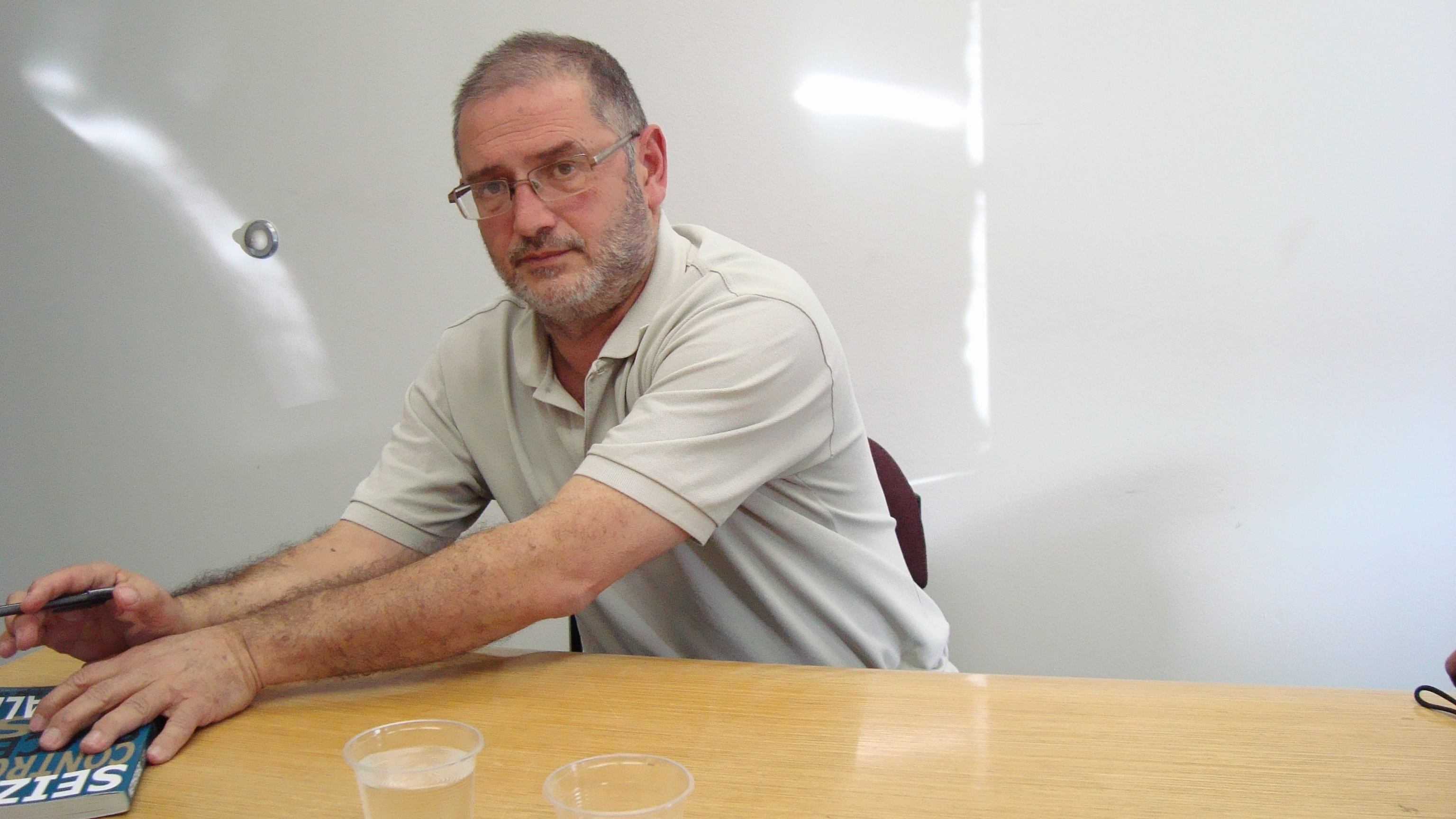
Yet, the day before, on 27 Dec. 2010, the Jerusalem Team and the Bethlehem Team met with Meir Margalit, an elected, left-leaning (Meretz party), Israeli member of the Jerusalem Municipal Council. He also published a book in 2010, Seizing Control of Space in East Jerusalem. Meir was able to describe part of our context in East Jerusalem regarding the 2020 Jerusalem Master Plan, initiated in 2000. Apparently, the municipality perceived that Palestinians were becoming the majority in Jerusalem and had the potential to elect a Palestinian mayor. Meir said, “This possibility makes the Israelis crazy.” The Master Plan is intended to “freeze the demographic situation” and has become a tool for denying licences for Palestinian construction of homes in Jerusalem. Another tool is home demolitions “to make life so hard for them [Palestinians], that they’ll leave Jerusalem”.
Meir works with Angela Godfrey-Goldstein (see my posting from 17 Dec. 2010) and Jeff Halper at the Israeli Committee Against House Demolitions (ICAHD). Licences for home construction are “almost impossible” for Palestinians to obtain. Members of ICAHD help families to rebuild.
Regarding his work as “fighting the Occupation from within the municipality”, Meir believes that the next year or two will be critical for resisting settlers’ seizing of East Jerusalem neighbourhoods such as Sheikh Jarrah and Silwan (see my posting from 25 Dec. 2010). From Meir’s perspective, one critical response is for international support for Boycott, Divestments, and Sanctions (BDS) [See Naomi Klein’s 2009 article]. In response to one EA’s question, “What can we do?” Meir responded by encouraging us to be in the most vulnerable East Jerusalem communities on a daily basis “to send the message to the Israeli government that we [the international community] won’t let this [ongoing effects of the Occupation] happen”.
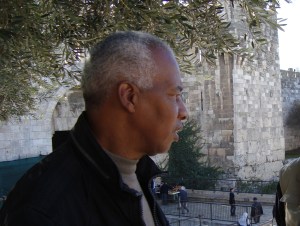
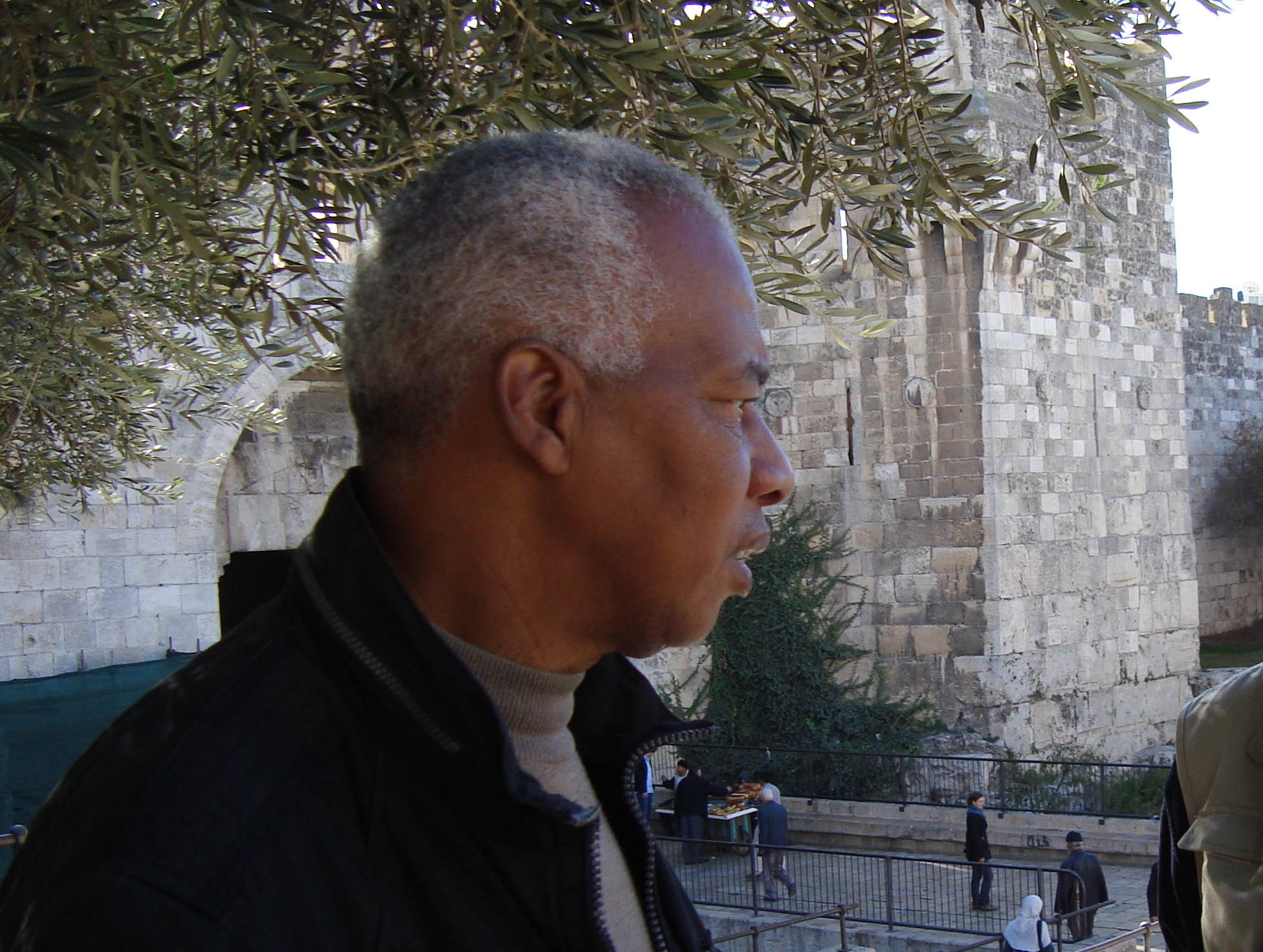
Reaching further back into last week, on the morning of 27 Dec. 2010, the Jerusalem Team embarked on a walking tour of the Old City with Mahmoud. He was born and raised in the Old City in the African area. His family came from Chad before he was born.
To our collective surprise, Mahmoud clarified that Jerusalem is “less than 1 km2 , but it is the most problematic area in the world.” Roughly, 35,000 people live in the Old City with about 23,000 Muslims, 8,000 Christians, and 3,000 Jews. Mahmoud’s vision is for:
- Jerusalem to be the “capital of the universe with free access to the city, as world heritage.”
- The Old City to be “a small model of the universe because people would come from all over the world.”
Mahmoud observed that, even now, people have moved from all over the world to the Old City. And, yet, they typically identify themselves as: “I am Jerusalemite.”
I heard hope here.
And, yet, on my days off, I wondered, what can I do…
Then Sune Fahlgren’s (Director, Bilda: Swedish Christian Study Centre, Old City) focus on “cultural freedom” came to mind…from our meeting with him on 22 Dec. 2010.
And Mahmoud’s heads-up about the protection of the Old City and his vision of it being for all…his reference to UNESCO doing its best to protect this endangered World Heritage Site.
And, then I looked to myself…who I am, what I’ve been trained to, what fascinates me…meaning making in terms of place and identity…
And, I picked up a small shell and remembered Margaret Mead’s often quoted observation…
“Never doubt that a small group of thoughtful, committed citizens can change the world. Indeed, it is the only thing that ever has.” Margaret Mead American anthropologist (1901 – 1978)
Happy New Year, All…I see a way forward into this next phase of Ecumenical Accompaniment as a member of Jerusalem Team 38… stay tuned…
Fear not…
Last night, about 20 EAPPI members (staff and Ecumenical Accompaniers) celebrated Christmas with the congregation and international guests of Evangelical Lutheran Christmas Church in Bethlehem. Rev. Mitri Raheb and Bishop Munib Younan presided along with additional Lutheran clergy. In his message, Bishop Younan offered these encouraging thoughts: “Palestinians and Israelis today face a common enemy: fear. In the absence of justice and peace, the common denominator is fear. Fear of the other. Fear for the future. Fear that freedom is not coming. Fear that children will grow in hatred. Fear of insecurity. Fear of the occupation. Fear is our common prison that keeps us locked up in cycles of mistrust and shattered dreams. It is a fear that builds non-productive ‘facts on the ground’. It is a fear that will only ever vanish when there is peace based on justice and reconciliation built on forgiveness. We proclaim that such a just peace is possible today. We pray that all political leaders will seize the opportunity before it is too late. The same message of the first Christmas rings true today, “Fear not!” There is a child who was born into a world of fear in order to take away that fear and to bring peace to earth and good will to humankind.”
Merry Christmas, All…
As a gift, I offer this photo array of a Nativity set crafted by Elias Giacaman of the Holy Land Arts Museum owned by Joseph E. Giacaman & Sons Co. Elias studied the scale of the Separation Wall in Bethlehem relative to the average height of people living in Bethlehem.
Salaam, shalom, peace…
Reflections on this first week of Ecumenical Accompaniment work…an intense experience…
On 20 December 2010, we attended the Christmas party in Sheikh Jarrah, an East Jerusalem neighbourhood in which Israeli settler groups have forcibly evicted the Palestinian, Al-Kurd, Hanoun, Al-Ghawi, and Rifhqa Al-Kurd families from their homes. Since late 2008, more than 60 Palestinians, including 24 children, have been forced onto the streets. Even as the settlers looked on, the evicted families celebrated and shared their hopes for 2011.
On 20 December 2010, we received this report: Human Rights Watch. (2010, December). Separate and Unequal: Israel’s Discriminatory Treatment of Palestinians in the Occupied Palestinian Territories. New York: Authors.
An excerpt, p. 5: “As the occupying power in the West Bank, including East Jerusalem, Israel is obliged to ensure the welfare of the occupied population and to limit its actions according to the law of occupation as set forth in international humanitarian law. In some cases, Israeli policies have made Palestinian communities virtually uninhabitable and effectively forced residents to leave. According to a survey of households in Area C and East Jerusalem in June 2009, some 31% of Palestinian residents had been discplaced since 2000 [see Save the Children document].”
On 21 December 2010… Within 1.5 hours, our Jerusalem team received three home-demolition alerts on my phone. We accompanied the family in the second demolition and tried unsuccessfully to locate the third demolition. The Bethlehem EAPPI team companied the family from the first demolition. Here is the information that we received in the Alert:
Demolition Working Group Alert 12:01 pm – Demolition ongoing of a Palestinian (inhabited) home in Ras al Ahmud in East Jerusalem.
In the final conversation that we had with Aida Musa Subah and her husband, Musa Ali Ibrahim Subah, he said, “We have no home.” He asked: “Pray for us. Thanks for coming. Maybe because you come here and are in solidarity [things will be better]….I will be alone but I know others will be here [i.e., because you will tell the world].”
On 22 December 2010, we responded to a request from the EAPPI UK/Eire Coordination office. They have asked us for quotations from Jerusalem residents, to be printed on a leaflet for use during World Week for Peace in Palestine and Israel (29 May – 4 June 2011).
We have started asking for local people’s thoughts…
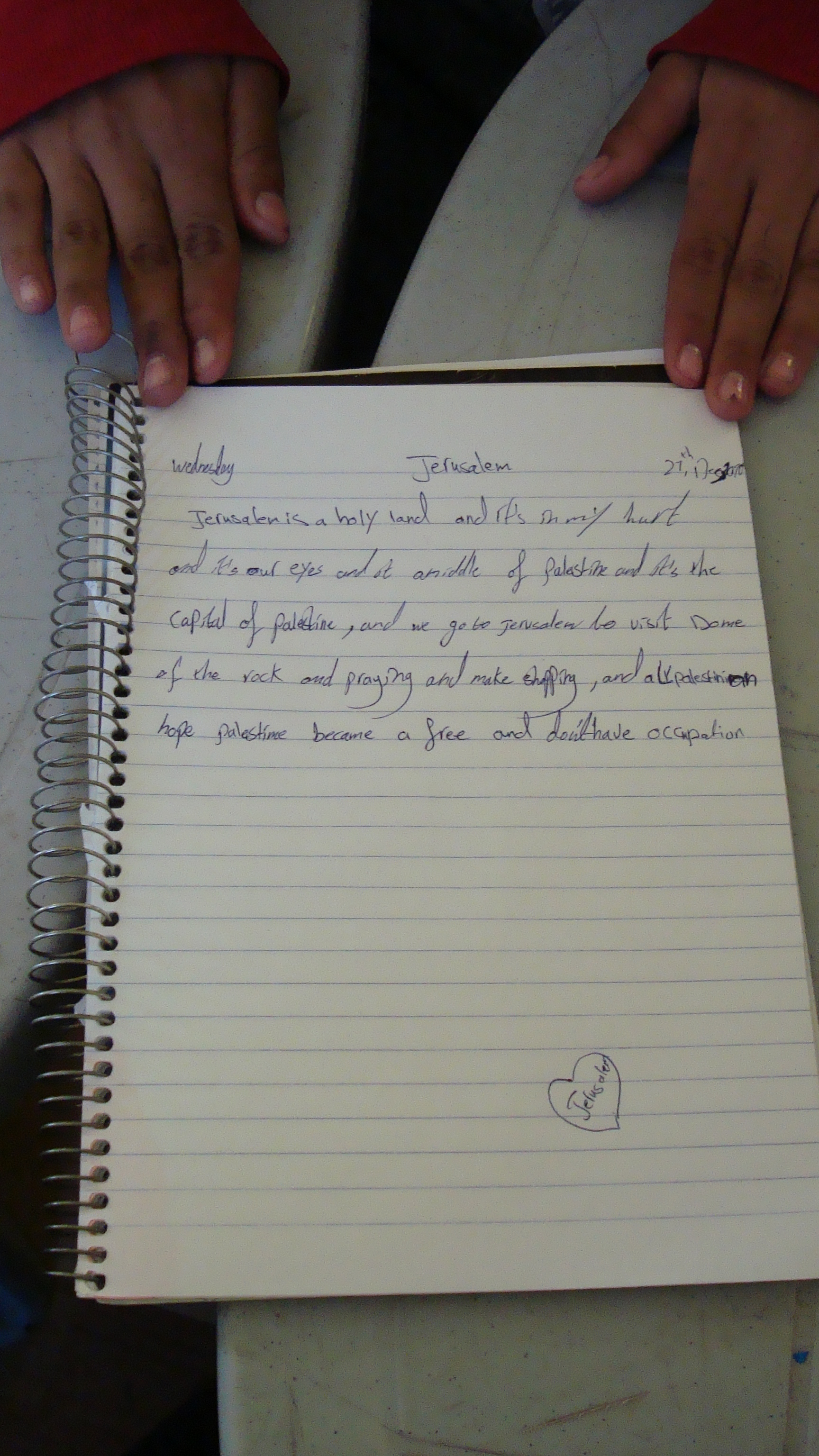
Jahalin Bedouin teen girl: “Jerusalem is my heart and my home.”
Note: Having already turned 16, she cannot visit Jerusalem except during Ramadan or if she has a health problem and if she can obtain a health permit.
Sune Fahlgren, Bilda: Swedish Christian Study Centre, Director: “Jerusalem is the cornerstone in this [peace] process…. There is no united effort to change it [the situation]. As long as the [Separation] Wall is not a problem for the rest of the world, what does it make inside [a person] for Israel to treat people [in such a] humiliating [way] at Checkpoints.”
On 23 December 2010, two of us attended Sabeel’s Communion service at 12 pm. Sabeel is the Ecumenical Liberation Theology Center in Jerusalem. The centre was founded by Rev. Dr. Naim Ateek in 1990 and works for justice, peace, and reconciliation in Palestine-Israel. The word, sabeel, is Arabic for ‘the way’ and also ‘a channel’ or ‘spring’. The weekly service is open to the community and facilitates a wave of prayer through the world’s time zones as individuals and groups pray together in solidarity with Sabeel in Jerusalem and with Friends of Sabeel worldwide.
On Thursday, Rev. Ateek invited us into conversation about what is righteous in a time of Occupation and how people might rise above unjust laws. He invited us to remember the meaning of the name given to Jesus, Emmanuel: “God with us”. We are not alone.
In searching online for information about Sabeel, I found this video (Oct. 2009) which concludes with this thought: “Keep the energy; keep the fire burning. I hope some of you will get together and begin working on a strategy because many of us cannot listen anymore to analysis. We must move beyond that to effecting change. And I think we can do it.”
It is happening again. Apartheid. Separation.
I heard the word, apartheid, in late April 2009 in Bethlehem. The Rev. Dr. Mitri Raheb used it during a conversation that he had with a group of 22 of us from Canada. One of us had asked him for his opinion about the conflict. I remember him saying that in the immediacy of the Lutheran ministry in Bethlehem, he was encouraged for the tremendous international support for the ministry. We were meeting in the beautiful space of the International Center of Bethlehem, Dar Annadwa Addawliyya ( دار الندوة الدولية). But he said, in terms of the bigger picture, ‘we are on our way to fully formed apartheid’.
I remember that moment as though I did a physical, mental, and emotional double-take. What? On the last day of that trip, the experience at the Qalandia checkpoint on the north side of East Jerusalem with Machsom Watch was a second shock to the system. A few of us witnessed the cattle-like processing of Palestinians through cages as they attempted to move from the West Bank to work, to school, and to hospitals in East Jerusalem.
Upon returning home in May 2009, I was moved to apply to EAPPI. And so, here I am. I’ve been here for ten days.
Today, on a tour with Angela Godfrey-Goldstein from the Israeli Committee Against House Demolitions (ICAHD), my mind and soul shuddered awake again… She explained that the word, apartheid, is Afrikaans for “separation” or “apartness”.
“Of course!!” my mind, soul, and body cries. Of course! This is what I’m seeing…in the blatant differences in municipal infrastructure on one side of Road No. 1 (the municipal name for the Green Line) – the West-Jerusalem side is spacious and bright – the East-Jerusalem side is crammed and crumbling. This is what I’m seeing as three types of armed personnel stand and roam the streets of the Old City with assault rifles. This is what I’m seeing when Israelis use only the Egged Busses and Palestinians use the ‘Green and Blue’ buses. This is what I’m seeing on the Ministry of Tourism map of The Old City of Jerusalem – that shows only Israeli parts of the Old City and sketches in parts to be built after evictions and demolitions (e.g., the Old City of David where the Palestinian neighbourhood of Silwan actually exists). This is what I see in the incomprehensible differences between (1) Bedouin villages on scraps of land being taken over by the settler-only access roads and municipal garbage dumps and (2) illegal settlements. This is what I see in the Separation Wall. This is what I see in the need for the Kairos Palestine document as comparable to the Kairos document published by black South African theologians in 1985 regarding South African Apartheid.
Also, this week, the members of EAPPI Group 38 were invited to Bethlehem to join an international delegation of women and local Heads of Church to mark the one-year anniversary of the release of the Kairos Palestine document. People spoke in hope, in faith, and in love that next year, on the second anniversary, we will be closer to peace. Rev. Dr. Mitri Raheb, one of the authors of the document, moderated the panel discussion.
And so the circle comes around. Apartheid. Separation.
Now, I find myself here with 24 other EAs from around the world, to offer protective presence to vulnerable communities, to monitor and report human rights abuses, and to support Palestinians and Israelis working together for peace. Now and when we return home, we will campaign for a just and peaceful resolution to the conflict through an end to the occupation, respect for international law, and implementation of UN resolutions. Angela Godfrey-Goldstein began her tour with these words about this apartheid state: “It will change only when ordinary people understand what is going on.” Our political leaders need to hear from us.
I will write more on all of this in the coming weeks and months…from the City of Peace.
Fullness of life here – Bedouin village visit
We’ve been in ‘learning mode’ with our mentors from Group 37, bunking in with them since Thursday evening. Today, Monday, we’ve returned to the hotel with the 21 other members of Group 38 for training through the end of this week. Through email and now in person, we are starting to hear about the experiences of the other teams (e.g., in Yanoun).
Here is an example of the fullness of our days:
11 Dec 2010: Slept in a bit – Catching up on the jet lag!!
Morning – Read the Handover report (from Group 37 to 38) and one of the UNOCHA (United Nations Office for the Coordination of Humanitarian Affairs) reports – polished the WallArt4Peace blog – did a little emailing.
Afternoon – Went with two of our EA mentors (both women) to Jahalin Bedouin village in Al Ezariya and spent the afternoon with our host, her sisters, little nieces and a nephew, and the English class for 15-16 year old girls. – Back home for a joint Jerusalem Team 37-38 meeting to discuss the Handover report. – Out to the Educational Bookstores – at one, I bought a notebook and 2 pencils and at the other, I bought the recently arrived Against the Wall book. (See my WallArt4Peace blog for more info.) Then bought a slice of pizza for a late supper and crashed.
Today, after a 6-hour stretch of sleep, we were up at 4:23 am (leaping out as our two EA mentors walked by our sleeping quarters) to meet the 4:40 am taxi for Qalandia checkpoint. What a windy and relatively cold morning…I’ll write more about checkpoint duty in the future.
The time with the women and girls at the Jahalin Bedouin village was enjoyable and enlightening. We laughed and had great fun with our host’s little people
and with the teens in their caravan community centre (2nd pic)! (See my KidsStories4Peace blog for more info.)
Our host graciously described the Jahalin story. In the mid-to-late 1970s, members of the extended Jahalin family were forced to leave their traditional way of life and the lands in which they used to live in the Negev desert near Beersheba. They moved north and then north again, living initially east of Jerusalem. However, with the establishment of the illegal Ma’aleh Adumim settlement, they were moved to the top of a nearby hill, near Al Ezariya (also known as Bethany and the place where Lazarus was raised from the dead). They had erected corrugated metal shelters as homes. On a day like we had on 11 Dec. 2010, with the winter wind howling and dust flying, that would have been a hard, desperate life.
After a number of years, they were granted permission to build permanent structures. Even then, however, those permits are good for only 40 years and the village is downwind from the municipal garbage dump where garbage is burned. On a fair weather day, the air quality is questionable; on the day that we visited, severe winds were scouring the hilltop.
Once they moved into these new homes, circumstances demanded further change of the Jahalin. Bedouin traditional life of the past was a nomadic life, as they moved their camels, sheep, and goat herds according to the seasons and the availability of water. Regular movement was healthy for the land (to avoid over-use) and for their interdependence with the land.
Our host remembered her father’s skepticism of their move into permanent, enclosed buildings as homes. For him, the prospect of living inside a building was not a healthy one. For example, he worried that electric light would damage their eyes. She rememers how their eyesight used to be acute and well-adjusted to the night sky.
Note: If you’re interested in learning more about the Jahalin family’s experiences, see the recent Separate and Unequal publication (p. 120) from Human Rights Watch. I’ve found this page which is very consistent with what we heard first-hand on 11 Dec. 2010. http://www.badil.org/en/al-majdal/item/1219-israel-continues-to-evict-jahalin-bedouin-from-west-bank-%5C And, here is a contemporary (1996) news report: http://www.wrmea.com/backissues/0796/9607065.htm .
Here is an independent documentary film about the marginalization of the Bedouin in the context of the State of Israeli as of March 2005. (Note: This film was produced prior to the withdrawal of Israeli settlements from Gaza in 2005.)
Finding our way
We, the members of EAPPI Group 38, started arriving in Jerusalem on 7 Dec. 2010, from around the world. We’ve begun to meet members of Group 37. Between these two groups (and more EAs are yet to arrive), we represent: Australia, Austria, Canada, Finland, Germany, Ireland, Norway, Palestine, South Africa, Sweden, Switzerland, United Kingdom, and the United States of America. Members of Group 37 introduced us to key spots in East and West Jerusalem yesterday and today and we were given our EA vests!! 
Over the next few days, Group 38 will be learning from Group 37 about our work in Jerusalem. We will be watching checkpoints (in which Palestinians must move from one type of zone of the West Bank to another and/or into East Jerusalem); standing with the Women in Black; providing an international presence in villages in East Jerusalem with eviction and demolition orders, and more.