“Structural violence is silent.”

Jean Zaru, a Palestinian Quaker woman*, offers this insight as she writes about the impact of the Israeli Government’s occupation of East Jerusalem, the West Bank, and Gaza. She offers a lens for analyzing structures of injustice such as political, cultural, economic, and social structures. In this posting, I focus on the Jerusalem Light Rail Train (JLRT) and how it is part of the silent, economic structural violence occurring in East Jerusalem. Through such violence, Palestinian society and Israeli society in Jerusalem are being torn apart. Ending this occupation and finding a just peace is critical for future co-existence.
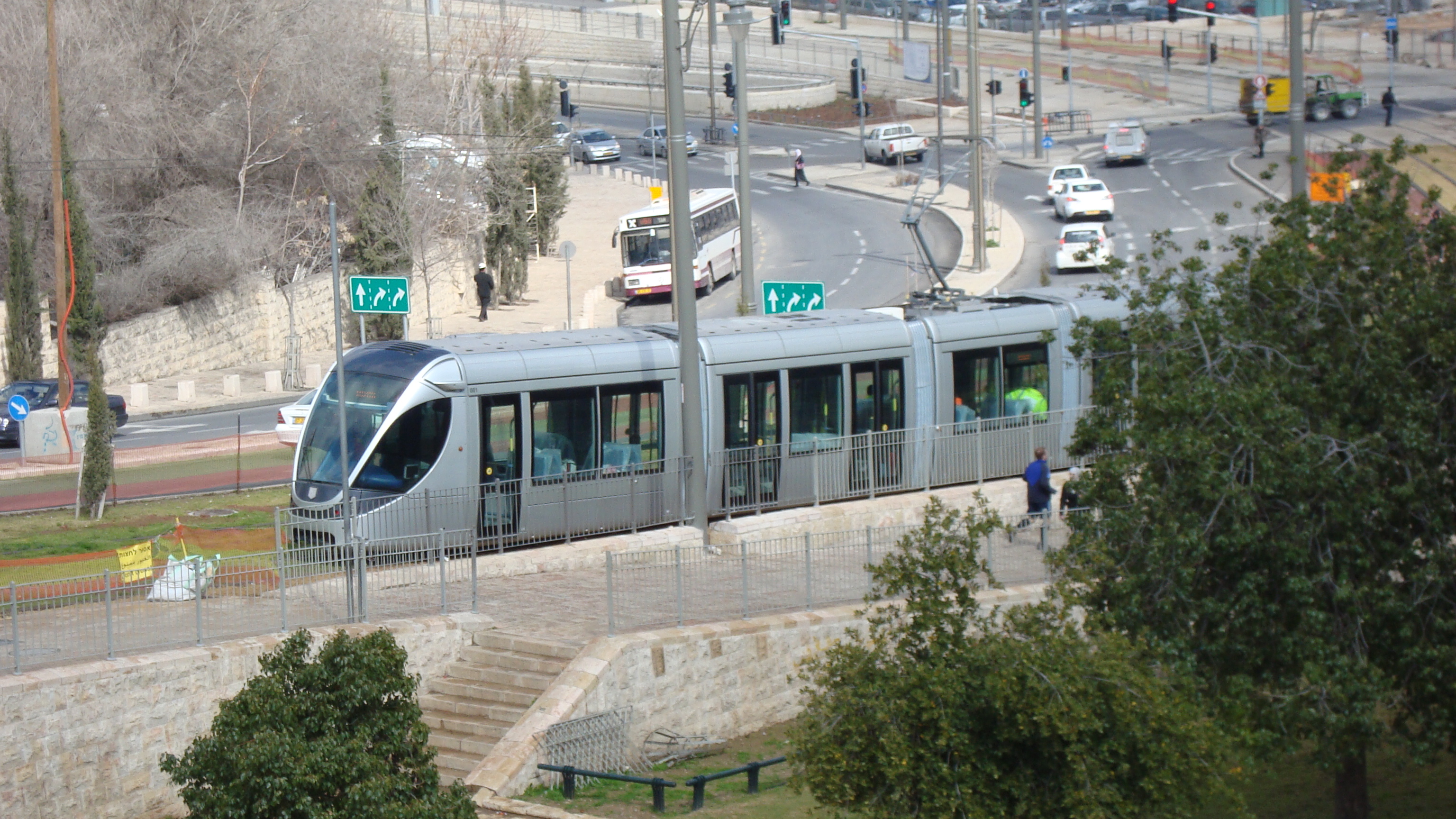
JLRT on the Green Line - Westbound, Jerusalem - 13 Feb. 2011 - Photo: Sherry Ann

The JLRT appears at first glance to be evidence of improved infrastructure in East Jerusalem. It has a sleek design and a street-level entry system for passengers. (See videos #1 and #2  [At the 4 min. point of #2, the JLRT drives past the site of the Palestinian home demolition in French Hill; I described it on 5 Jan. 2011]). However, this new transportation feature is a bizarre sight amid the crumbling environment that is East Jerusalem. The Jerusalem municipality is responsible for maintaining the infrastructure of East Jerusalem; and yet, despite paying into the same tax system as people from West Jerusalem, those in East Jerusalem are watching their area fall apart.

JLRT tracks on the Green Line – West Jerusalem is on the left. East Jerusalem is on the right. – 13 Feb. 2011 – Photo: Sherry Ann

“…the Jerusalem municipality has not provided adequate planning, construction or infrastructure to their [East Jerusalemite] neighborhoods for decades, a legacy of discriminatory neglect that starkly contrasts with the general situation in West Jerusalem and in Jewish settlements in East Jerusalem. 115 … The municipality itself is responsible for the poor condition of the road and sewage networks in East Jerusalem, and for the dense and unplanned nature of its residential areas, in sharp distinction to Western Jerusalem.” (Separate & Unequal, 2010, p. 50; the superscript note “115” refers to the following document: ACRI, “Human Rights in East Jerusalem – Facts and Figures, May 2010,”).

JLRT Westbound by the Old City, Jerusalem - 13 Feb. 2011 - Photo: Sherry Ann

Upon closer examination, the JLRT is an ominous development. East Jerusalem is occupied, yet through illegal settlements, the Israeli Government is transporting Israeli citizens into this occupied territory.  Through the JLRT, settlers are being given ease of access to central Jerusalem  for work, school, and other daily activities. (See the locations of settlements in the deep purple on this map). This population transfer is a war crime according to Article 49(6) of the Fourth Geneva Convention (see here and here).

By creating this people-mover system, the Israeli Government is proceeding with its annexation of East Jerusalem toward its goal of a united capital for the state of Israel. Such annexation is illegal according to international humanitarian law (See here and here).

Public notice banner - Shu'afat, East Jerusalem - 10 Dec. 2010 - Photo: Sherry Ann

Planning for the JLRT began in 2000. By 2020, the network is to have eight lines. The first line is nearing completion. Since December 2010, we have watched trains out for test drives and we have sat in public buses in the traffic caused by the construction, particularly in Shu’afat. This is a neighbourhood through which the JLRT will travel as it heads north and then east. To build the JLRT tracks, the Israeli Government has expropriated Palestinian private property; in addition, public roadways and parking spaces have been taken over to reconfigure space for the JLRT tracks. With little space in which to drive and/or park, local shoppers have been less able to support local businesses. The destruction of property in occupied territory is illegal according to Article 53 of the Fourth Geneva Convention and the confiscation of property in occupied territory is illegal according to Article 46 of the Hague Regulations. Worth noting is that only 3 of 23 stops on this first JLRT line are in Palestinian areas. The other 20 stops are located in West Jerusalem, along the Green Line, and in the illegal settlements of East Jerusalem.  (Note: The Green Line is termed Route No.1 on this map.)

JLRT track construction - Shu'afat, Jerusalem - 10 Dec. 2010 - Photo: Sherry Ann

I perceive that the JLRT is an example of economic structural violence. Jean Zaru observes that, “Violence, after all, is not only about war and weaponry. Political, cultural, economic, and social structures have been at work in a destructive way throughout our community” (Zaru, 2008, p. 61). The examples that she gives for economic structural violence include restricted freedom of movement by Israeli  road blocks and control of roads; economic marginalization and exclusion; and destruction of civil society and infrastructure.

After three months of riding the Green bus to and from Shu’afat refugee camp, Qalandiya Checkpoint, and the Old City (all in East Jerusalem), this violence seems mind-bendingly subtle. Looking out the window, I see a diversity of people in terms of ethnicity, race, religion, age, gender, profession, civilian/military status. Yet, East Jerusalem is not a place in which all of these people mix and mingle easily. The Israeli citizens who live in East-Jerusalem settlements have an illegal presence. I’ve heard local people speculating about the anticipated ridership of this JLRT; it would seem that West Jerusalemites and the illegal settlers may benefit most. An unnamed separation exists amid the apparently benign streetscape.
JLRT Safety banner – Shu’afat, Jerusalem – 10 Dec. 2010 – Photo: Sherry Ann

I regard Jean Zaru’s analytic lens helpful. She writes:

“Structural violence is silent. It does not show. Television captures the direct violence and most often the violence of the powerless and the hopeless, and it is headlined as terror. One basic weakness in most conceptualizations of violence in the Israeli-Palestinian conflict is the basic assumption of symmetry, which views contending parties in conflict as being equal. After all, the conflict is there because we are unequal. We are unequal in access to power, media, and influence. But we insist that we are not unequal in our rights.” (Zaru, 2008, p. 62)

The corporate complicity in the construction of the JLRT is a dimension of economic support for the Israeli Government’s occupation of East Jerusalem. See this article and its references for more info.

Peace from the Old City Ramparts - JLRT tracks, Green Line - Jerusalem - 13 Feb. 2011 - Photo: Sherry Ann

With this posting, I am beginning my transition from an on-the-ground witness as an Ecumenical Accompanier. Over the next week or two, I will return to the vantage point of Canada. I will become an Ecumenical Advocate holding dear the relationships that I’ve developed here with those who have shared their experiences with me.

Please pass along the address for this blog to friends, family, colleagues, and acquaintances. Check out the links for various publications. We need to start talking about these silent forms of violence as much as we talk about the news headlines. In this way, we as global citizens can contribute to ending the silence and the occupation.

* Jean Zaru is the Presiding Clerk of the Friends Meeting House in Ramallah and a founding member of Sabeel, an ecumenical Palestine Liberation Theology Center in Jerusalem.

For additional information, see:

Barghouti, O. (2009). Derailing Injustice: Palestinian Civil Resistance to the “Jerusalem Light Rail”. Jerusalem Quarterly, 38, 46-58. Available here.

The Civic Coalition for Defending Palestinians’ Rights in Jerusalem. (2009). The Jerusalem Light Rail Train: Consequences and Effect. Jerusalem: Authors. Available here.  

Diakonia’s webpage regarding the JLRT and its violation of international humanitarian law. Available here.  

Ecumenical Accompaniment Programme in Palestine and Israel. See: http://www.eappi.org/

Human Rights Watch. (2010, Dec.). Separate and Unequal: Israel’s Discriminatory Treatment of Palestinians in the Occupied Palestinian Territories. New York: Authors. Available here

Zaru, Jean. (2008). Occupied with Nonviolence: A Palestinian Woman Speaks. Foreword by Rosemary Radford Ruether. Minneapolis, MN: Fortress Press.
Choosing to participate is an amazing act of courage to know ‘the other’.

In May 2009, 22 of us from Canada shared a very special visit in Jerusalem with Dalia Landau. She co-founded Open House Ramle with Bashir Al-Khayri in 1991. She continues to serve as Co-Director of Open House as it celebrates its 20th anniversary in 2011. On that day in May 2009, she described the story that she shares with Bashir, as recounted in the book, The Lemon Tree, by Sandy Tolen. In describing how her life is intertwined with Bashir’s life, I came to appreciate how Dalia has, time and again, chosen to live in the heart of the Israeli-Palestinian conflict. Many times, she has been presented with a choice to leave the tension, confusion, and pain of the conflict. Each time, she has chosen to continue to lean into it to try to make a difference.

Dalia Landau - Jerusalem - 14 Feb. 2011 - Photo: Sherry Ann


Through Open House, she and others, who are also trying to make a difference, have been creating spaces for children and youth who are Israeli and Palestinian, Jewish, Muslim, and Christian to play, talk, and listen to each other. 
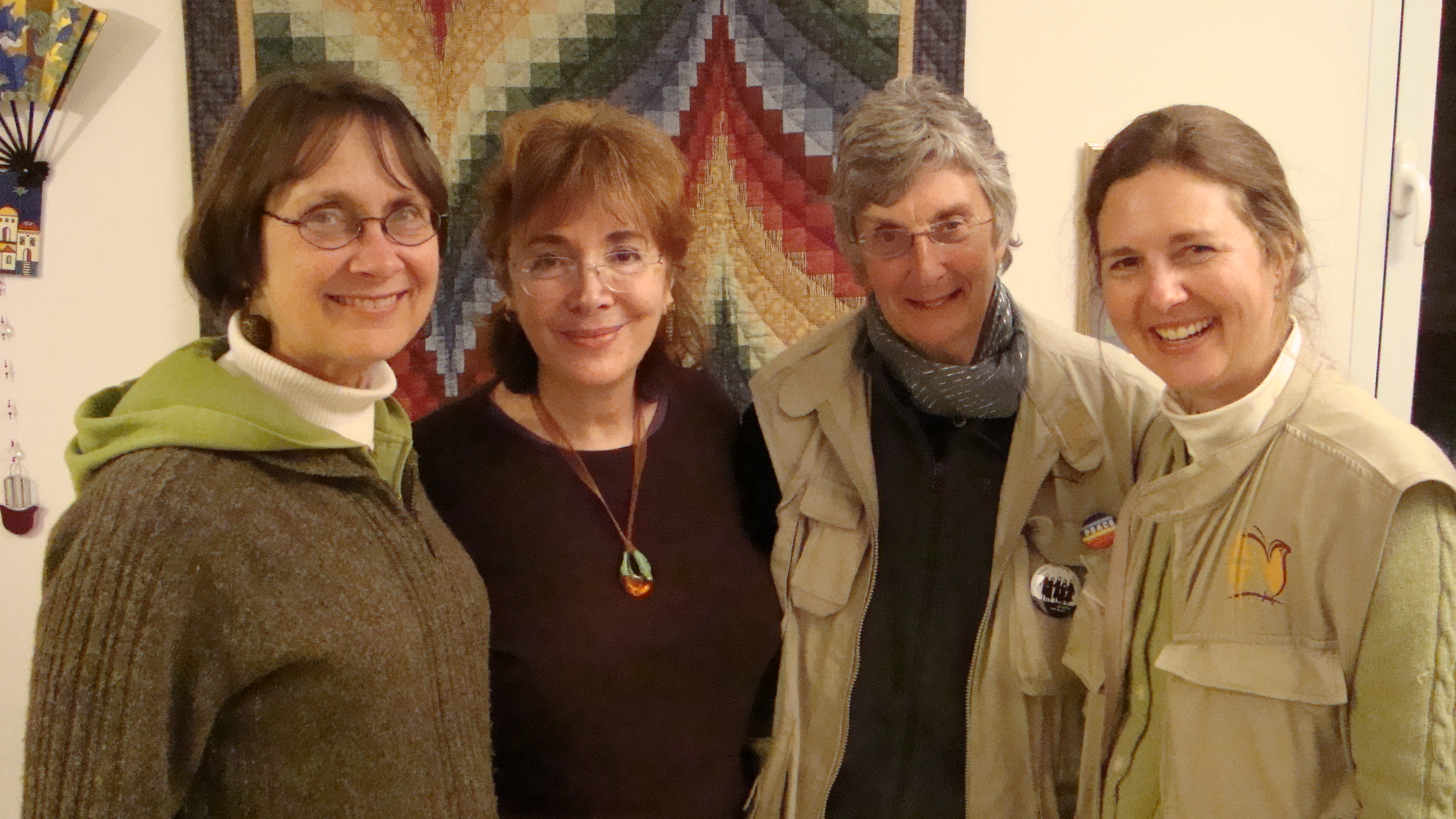
On 14 Feb. 2011, three of us, Ecumenical Accompaniers, shared a meal with Dalia. The evening was very meaningful for us who have spent almost three months walking with Palestinians and Israelis who are working to end the Israeli Government’s occupation of Palestine. We have seen and heard conflict and pain. We have felt so many emotions. We have asked to hear people’s stories. We have discussed details of international humanitarian law. We have asked for clarification. We have listened, and we have listened some more. Even amid the challenging moments, we have also shared the joys of daily life here. We have shared a sense of solidarity with those who have opened their hearts and homes to us.

Dalia and we, 3, Ecumenical Accompaniers - Jerusalem - 14 Feb. 2011 - Photo: Guest

On that evening with Dalia, I came to appreciate how we, EAs, have been able to develop relationships with both Palestinians and Israelis. Yet, due to the Israeli Government’s ‘security’ efforts, Israeli and Palestinian societies are separated more and more each day. You might recall how I quoted Angela Godfrey-Goldstein’s comments in December about this apartheid state: “It will change only when ordinary people understand what is going on.”

Here’s a glimpse of what Dalia and the Open House staff and volunteers are doing to help children and youth in Israel and Palestine to make informed choices with each other in mind. With the support of Open House, these young ones are growing into extraordinary people, working for social justice and peace. Click here and here

Dalia shared the following reflections:

“There’s a whole generation that is growing that doesn’t know each other. Before the First Intifada [started in 1987], Israelis used to go massively to Bethlehem – it was good to know each other – going for the restaurants and the souk. Now, there’s a whole generation [of Palestinians] who doesn’t know Israelis. For them, we’re a mythology. And, the same is true for the other side.”

“Just knowing each other makes a difference. We work long term with people at Open House. We start very early [for example, at two and three years of age]. Mainly, we work with Arab Israelis; it’s more difficult to arrange for West Bank youth to participate. One individual serves as a window to a whole other world. This has been very strong in my life. How through one person with an authentic relationship, you realize: They’re like me.” [Click here.]

“It was also when I met Bashir when they knocked on the door in 1967 to see the house, their house, they were three people, from the same family. Then I went to Ramallah to visit Bashir’s family; it was just after the [1967] war… . His family was probably asking, “Who is this person?” I could see their thoughts…. But it’s through the ‘joy in the encounter’ – then, one creates trust. Depending on the age group, you can bring up issues. Like teens, during the [Second] Intifada, they would discuss incredibly deep issues – it moves the heart – how they stuck it out. They came back every week – it was unbelievable – the courage of it. One group of Jewish Israelis, they were 18 years old, pre-army, found us on the Internet. They were doing social service (e.g., volunteering at schools to speak about ethical issues). They wrote describing, “We’re going to the army in one year yet we haven’t ever met any Arabs”. They had grown up in Jewish neighbourhoods in Tel Aviv and had had no dialogue with Arabs. They wondered, “How were they going to justify going into the army. They asked Open House if we would arrange a dialogue for them [with Arab Israeli teens.] We met with them for one year. They were very evolved human beings. It was during the [Second] Intifada. The richness of the issues they raised! Of course, the Arabs [teens] confronted them: “Why don’t you do conscientious objection?” Most of the Arab and Jewish teens agreed to disagree. Some friendships broke down. Of course, the encounter is very, very deep. If it’s compulsory service, a person has no choice. But they wanted to explain why going into the army was important [for them]. For example, “We protect all citizens including you [as Arab Israelis].” “I want to be in the IDF – the Israeli Defence Force. Without the army, Israel wouldn’t exist for a moment. So, we’re paying the price.” Click here.

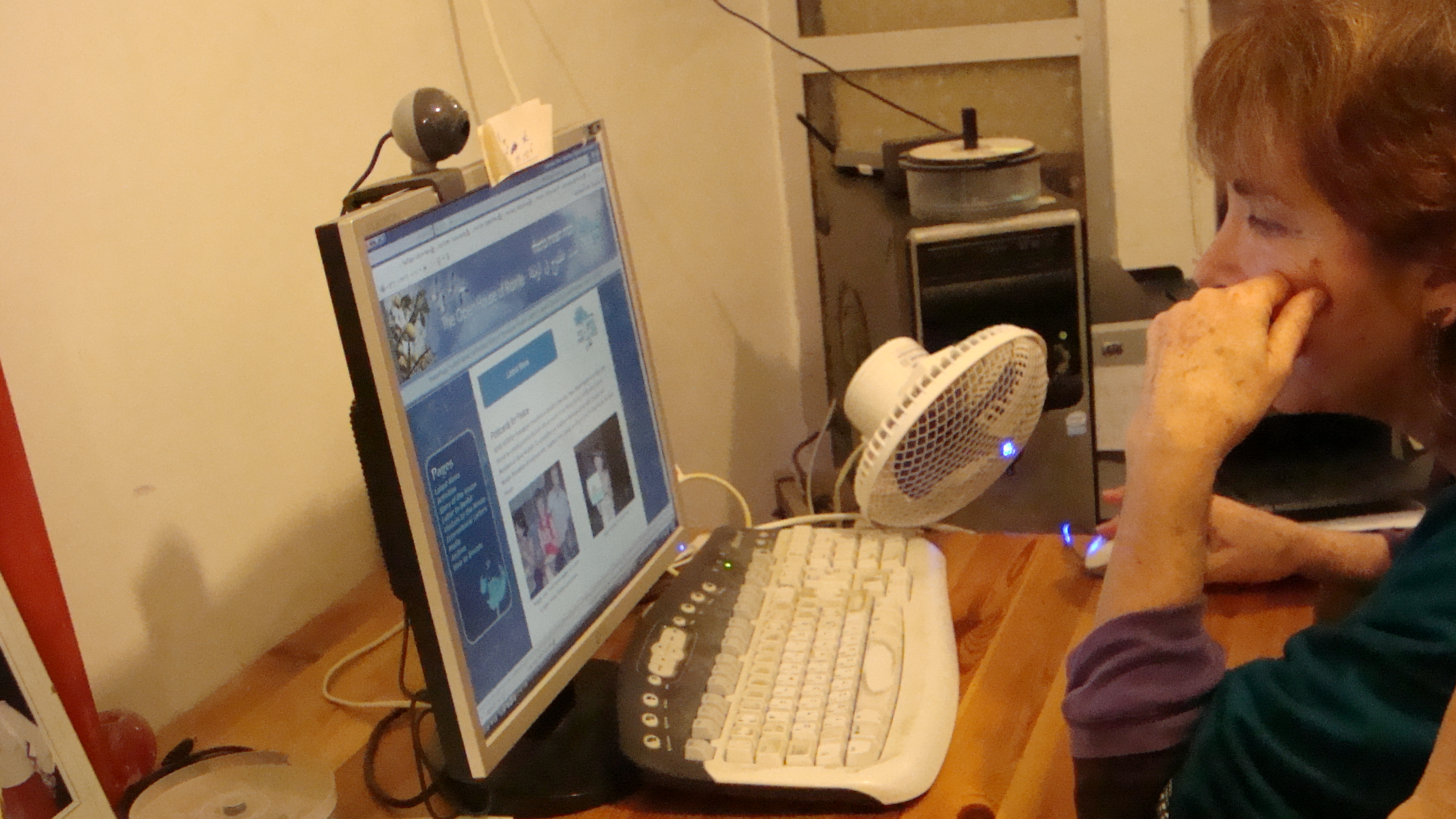
Dalia & the Open House Ramle website - 14 Feb. 2011 - Photo: Sherry Ann

“If you visit the website and then, scrolling down on the left-hand side, you will see “Highlights”, including a discussion by young adults after the “War in Gaza” – it was so deep – that type of discussion needs careful facilitation to avoid acrimonious dynamics. A discussion can make tensions worse than they were prior to the discussion. Through my life, I have learned methods for creating sacred space in the middle and appreciate how each person brings their reflection where they are in the moment – allowing silence – calling the other person by name – “What do you feel after this war” – It’s extremely important when people start to become defensive – that’s the opposite of inner listening. Developing these techniques of discussion has been part of my own journey.”

“In the Open House summer camps, the children are choosing to participate in an amazing act of courage to know ‘the other’. While parents support the activity, each child is making the choice to participate. Some grow up to become counselors in the summer camps. The first summer camp was held in 1992 with children who were 8 to 10 years old. Then we included children up to 13 years and children as young as 6 years.”

“The summer camp and teen programming have two objectives: (i) affirmative action for the Arab population (e.g., developing respect for culture and promotion of the Arabic language); and (ii) co-existence – two communities living together. Both types of programming require funds not only for staff but for materials and resources; the children are not just spending time together but also working together (e.g., creating a sculpture of sheep in a public garden in Ramle). They have created an Open House mosaic in the centre of Ramle – they used discarded materials which required breaking them down and designing a concept for the piece.”

“For older children, high-school students, “The Journey” program, they travel throughout the country and hear the narratives of all parties. It is an intense week-long experience.”  Click here and here

“We also have big events in cooperation with Neve Shalom/Wahat al-Salam in which we bring together young people for two or three days, twice each year, for music, dance, tents, and discussion. That programming has been supported by a Japanese Buddhist organization for over ten years. Developing and continuing funding relationships is critical. Some organizations offer three-year, seed funding; however, regular and dependable support is needed. For example, one woman in Holland has created a tax deductible venue in which four churches participate. Another example is one professor who turned to his friends at a university. They now do an annual collection at Christmas time, in support of Open House. A group at a synagogue in the US, working with local Palestinian Muslims, created a postcard project in 2010. They asked for drawings from children in the Open House nursery school and the summer camps. Those drawings were scanned and printed on postcards and cards which are sold in packages of ten cards for $20 (US). The postcard idea would be easy to adopt elsewhere because the drawings are already scanned.”

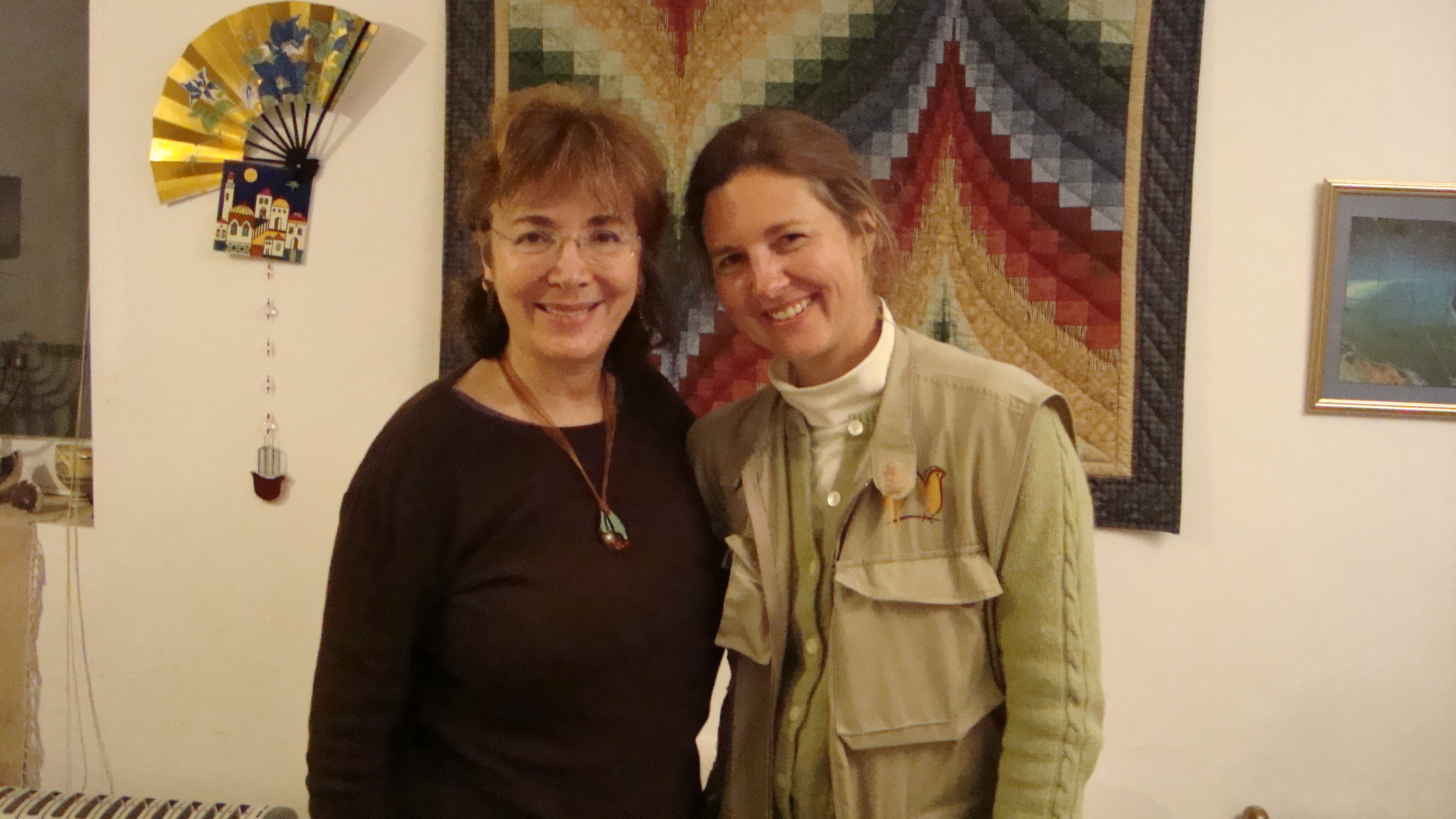
Dalia & Sherry Ann – Jerusalem – 14 Feb. 2011 – Photo: Guest

As Open House Ramle celebrates its 20th anniversary in 2011, they will be renewing the year-round co-existence programming. The summer camps  have continued every year but the year-round programming stopped for a few years due to lack of funding. The hope is to undertake a joint sculpture project. Through the course of one year, children in an Arab school and children in a Jewish school will each develop a sculpture or a complex of sculptures with a professional artist who is an Orthodox-Christian Arab. At the end of the year, the children will exchange the pieces as gifts. For that year, they will be thinking of ‘the other’.

As I begin to wrap up my time as an Ecumenical Accompanier in Palestine and Israel, reflecting on these co-existence efforts of Open House is helpful for seeing the hope that persists in this place. I invite you to watch this two-minute video [Click here. A new window will open. Scroll sideways to the right – drag the bar sideways at the bottow of the browser window. Wait for the video to download – will take about 2 min.] 

To visit additional resources, look for the underlined words (they’re hyperlinked) throughout this posting including three links below.

Radio documentary about The Lemon Tree by Homelands Productions 

A clip about Dalia Laudau and Bashir Al-Khayri’s story in this documentary film, “Holy Land: Common Ground” 

Sandy Tolen on writing the book, The Lemon Tree

“Go in Peace”

On visiting Eilat…a thin wedge of desert between the Sinai Peninsula in Egypt and Jordan…on the Gulf of Aqaba…

This slideshow requires JavaScript.

It’s Elemental

In awe

Hearts pounding

Disbelieving

Braced in the wind

In awe of this element of water

Salty

Surging

We stand, with cameras poised

Trying to capture, though never completely,

The sight of this surf.

But it isn’t just a sight or sound or taste.

It is bigger, a feeling that moves through, and past, each and all of us.

Where are you from?
What language do you speak?

Does it matter…

It’s a feeling that moves through, and past, each and all of us.

“Go in Peace”

in awe…

-Sherry Ann (15 Feb. 2011)

Checkpoint Control

“The army plays with us like sheep. It’s humiliating. I can’t stand it.”  -In conversation with a medical doctor describing the Qalandiya Checkpoint, 14 Feb. 2011.

For an article about the recent closure of Hawara Checkpoint north of Jerusalem and of Ramallah and south of Nablus, click here.

This slideshow requires JavaScript.

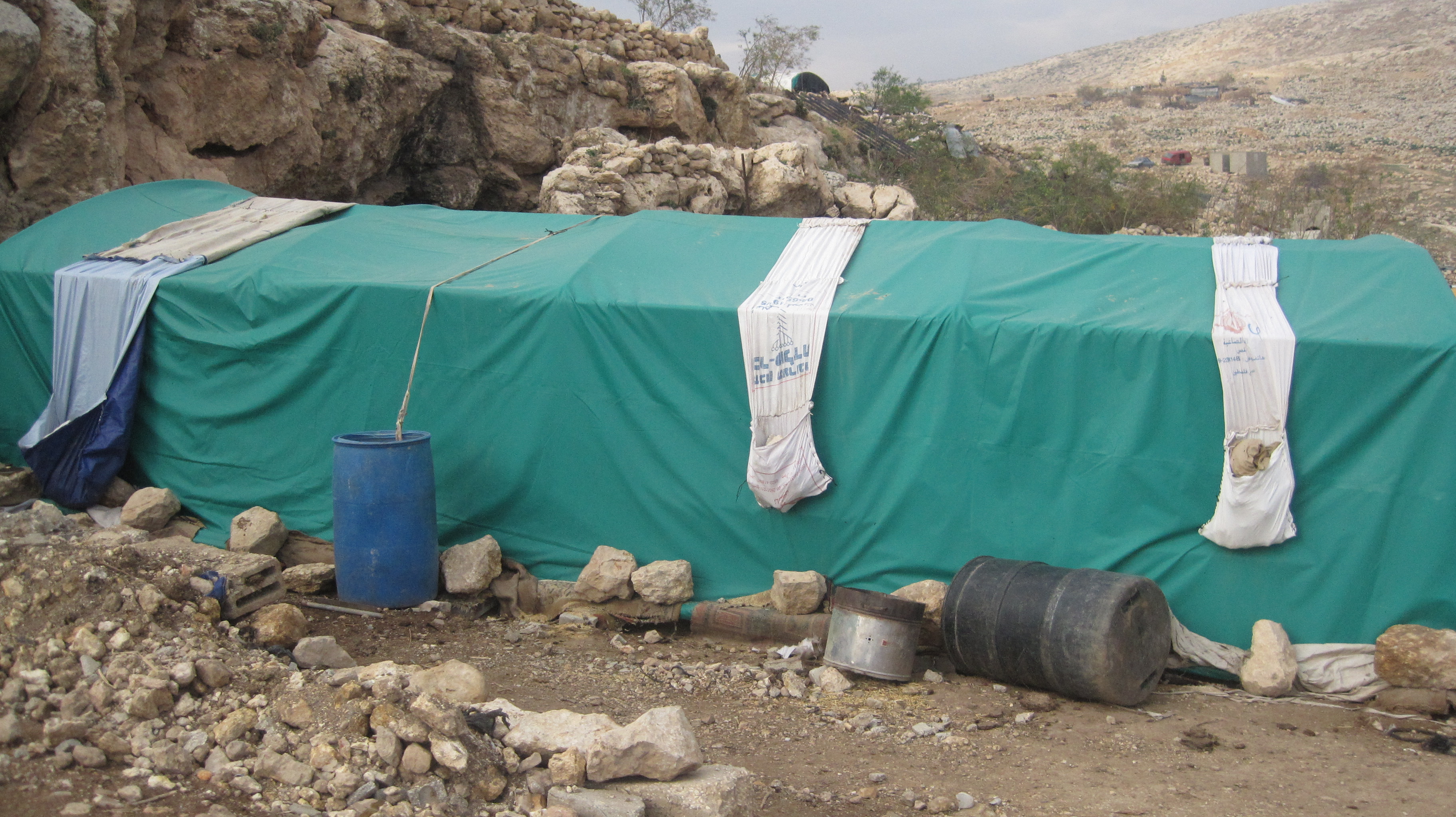
Army makes 50 homeless: Jordan Valley Demolitions

Usra Ahmed Hanani with Ann Farr, EA - Khirbet Tana - 9 Feb. 2011 - Photo: P. Hanseid

The EAPPI Team in Yanoun stood with the people of Khirbet Tana this past week after their homes and animal shelters were demolished by the Israeli Army for the fourth time in recent years.

Rafi Mahmoud Hanani's makeshift sheep shelter before demolition - Khirbet Tana - Jan. 2011 - Photo: Ann Farr

For the full story, click here.

For additional photos, click here.

After the demolition. Rafi Mahmoud Hanani with the wreckage of his animal shelter – Khirbet Tana – 9 Feb. 2011 – Photo: P. Hanseid

For a descriptive Fact Sheet from the United Nations Office for the Coordination of Humanitarian Affairs (UNOCHA), click here.

Placement visit: Hebron

On 5-6 Feb. 2011, I visited the EAPPI team that is placed in Hebron. I don’t expect that I will forget these 24 hours very quickly. I arrived in time for the settler tour. This is a 3-pm event on Saturdays in the Old City of Hebron. On 5 Feb. 2011, about 35 Jews visited under the eye of about 20, fully armed, Israeli soldiers.

Some background info:

From Wikipedia – “Hebron (Arabic: الخليل or al-Ḫalīl) (Hebrew: חֶבְרוֹן or Ḥevron or Ḥeḇrôn) is located in the southern West Bank, 30 km (19 mi) south of Jerusalem. Nestled in the Judean Mountains, it lies 930 meters (3,050 ft) above sea level. It is the largest city in the West Bank and home to around 165,000 Palestinians,[1] and over 500 Jewish settlers concentrated in and around the old quarter.[2][3][4][5][6] The city is most notable for containing the traditional burial site of the biblical Patriarchs and Matriarchs and is therefore considered the second-holiest city in Judaism after Jerusalem.[7] The city is also venerated by Muslims for its association with Abraham[8] and was traditionally viewed as one of the “four holy cities of Islam.”[9][10][11][12]

From a 2009 travel book that I bought (see this webpage and scroll to the end of the page for a sample of this English-language document) – “In the old city there are 5 settlements, with a total of around 500 Jewish settlers coming mainly from the United States and France. They are located along the Street of the Martyrs, from which Palestinians are banned, which links Kyriat Arba to Tell Er-Rumeida. The settlers are well armed and protected by between 1,500 and 2,000 Israeli soldiers. What used to be the centre of commercial and social activity in Hebron is today both bleak and depressing. Although it retains its authentic character the old city is being strangled by the restrictions, which are enforced by metal barriers, turnstiles, omnipresent barbed wire, and blocks of concrete.

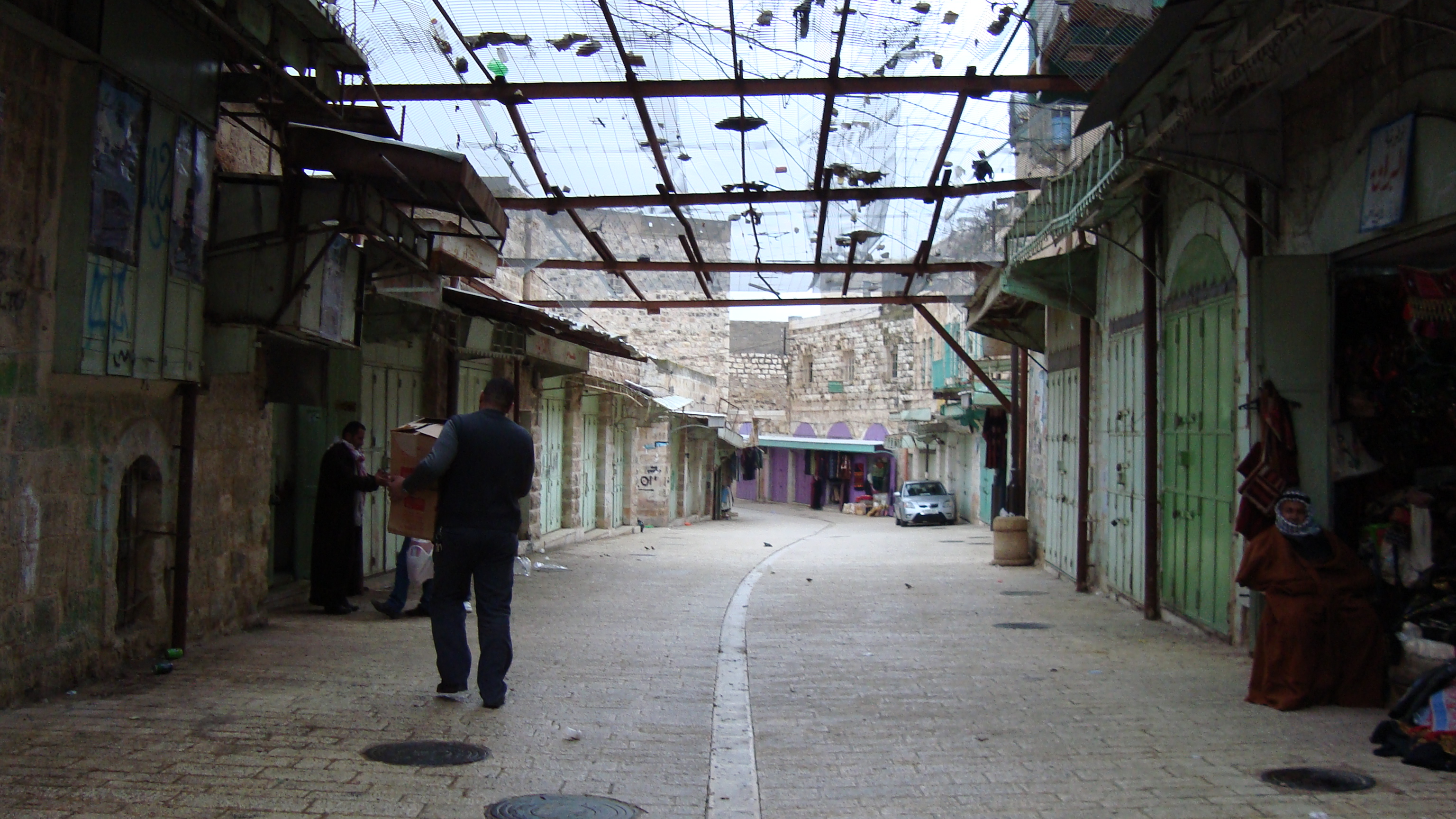
Old City, Hebron – 5 Feb. 2011 – Photo: Sherry Ann

Wire grills have had to be installed to protect Palestinian passersby from rubbish and rubble thrown down by Jewish settlers from the upper storeys [sic] of illegally occupied houses, which used to be inhabited by Palestinian families. Moreover, a number of modern Israeli buildings and other structures have been built that clash with the architecture of the old city and spoil its traditional character.” (p. 33)

I walked with Laura, an EAPPI Hebron Team member, behind the 12 soldiers who walked behind the tour group. (Eight soldiers walked ahead of the group.) At the end of the tour, we found ourselves exiting a laneway and inadvertently between the main group and three tour members who had stopped to take a few final photos. Two soldiers accompanied the three people as they walked by us and joined the rest of the group before entering this gate.

Israeli Army gate & watch tower - Old City, Hebron - 5 Feb. 2011 - Photo: Sherry Ann

One woman called out to Laura and me:

“Shame on you!!”

Why?

Who do you see within this vest?

Within this skin?

What do you see?

What label?

Me?

Who are you that you see me in this way?

What has brought us together in this place?

I am guessing that you have more layers than this surface.

I can feel them. And the fear. And your shock.

Can you feel my shock?

Are you feeling a kind of oppressive pressure-like nausea, too?

Your accent sounds North-American, like mine perhaps…

What is your name…

My name is Sherry Ann…

I am a visitor here, too…who cares…

Perhaps, we will meet again…

Perhaps, we might find ourselves in a discussion about this place…

I hope that you might see me, then…I hope that I will be allowed to see and hear more of your layers…

Until then…

Shalom

Assalaamu alaykum

Peace be with you.

-Sherry Ann (6-8 Feb. 2011)

“Most people – Christian, Muslim, and Jews – we just want peace.”

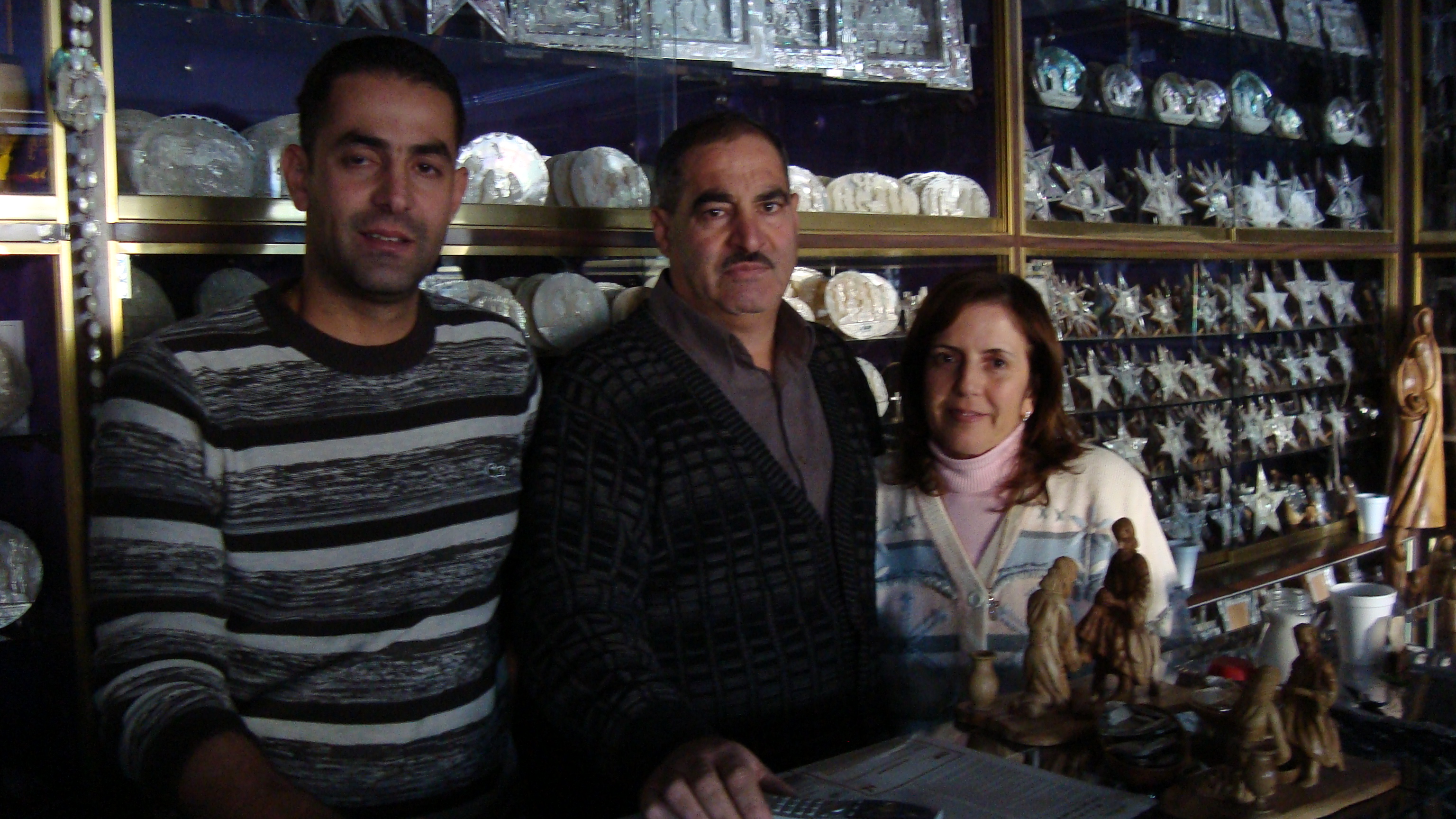
Elias Giacaman is a Palestinian Christian who believes in peace. He is an olive-wood craftsman from a multi-generational, familial tradition. He also manages the family business, Joseph E. Giacaman & Sons Co., with his father, Joseph, and mother, Mary.

Giacaman Family - Bethlehem - 16 Dec. 2010 - Photo: Sherry Ann


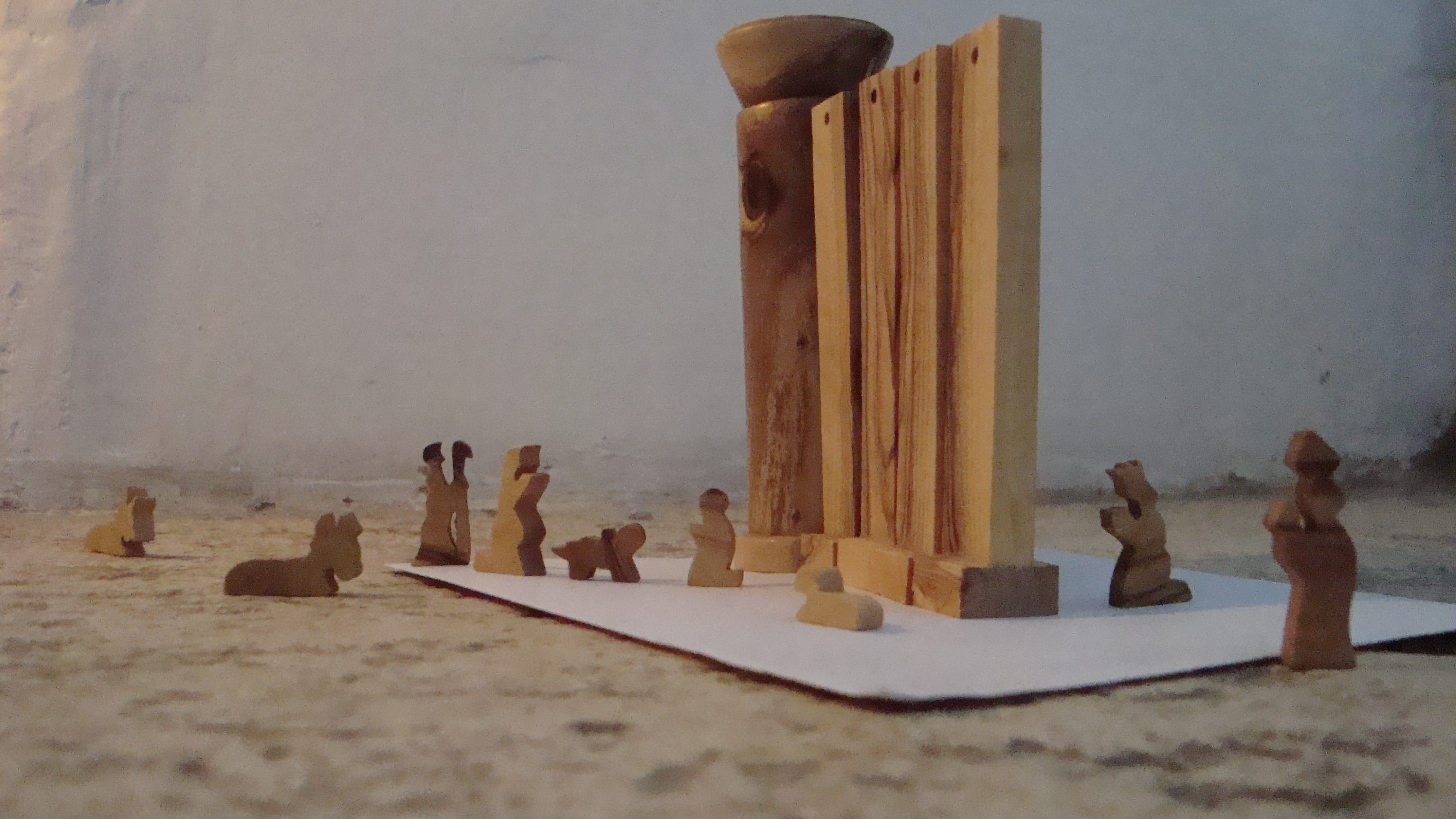
You may remember Elias’ name from my posting on 25 Dec. 2010. He crafted the Nativity set that demonstrates the scale of the Separation Wall in Bethlehem. He and his family know the story of the Wall very well.

Nativity Set, E. Giacaman - Bethlehem - 25 Dec. 2010 - Photo: Sherry Ann


The family business was established in 1928 by Elias’ grandfather, a time when Christians made up about 9% of the population of what was then British-Mandate Palestine, roughly what is now Israel-Palestine. The shop was located in a building in the centre of Manger Square. By the 1970s, that building had been taken down. The shop is now located in a newer building on the right-hand side of Manger Square when facing the Church of the Nativity.

The Giacaman family is part of a diminishing Christian community in Israel-Palestine. People are emigrating primarily due to a lack of freedom and security, a poor economic situation, and political instability (see report). In 2007, Palestinian Christians in the West Bank, the Gaza Strip, and Jerusalem made up only 1.37% of the population; the figure in 2010 was estimated at 1.25%.

One of the many impacts of the Israeli Occupation is restricted movement for Palestinian Christians and Muslims. The Government of Israel began building the Separation Barrier or Wall in 2002. When completed, the Barrier will be 707 km long. For most of its length, the Barrier is fortified fencing; however, in populated areas such as that between East Jerusalem and Bethlehem, the Barrier is concrete wall. For a sense of scale, the Berlin Wall was 11.8 feet (3.6 metres) high. The Separation Wall stretches as high as 25 feet (8 metres). Fifteen percent of the Barrier is being built on the Green Line and 85%  on land inside the occupied Palestinian territory. (The Green Line is the 1949 Armistice line following the declaration of the state of Israel; the Green Line marks the line between Israel and the West Bank. See this map and how the black line, representing the Separation Barrier, weaves in and out from the green, dotted line.) While the Government of Israel has a right to protect its citizens, the International Court of Justice (ICJ) (the principal judicial body of the United Nations) advised in 2004 that the sections of the Wall that run inside the West Bank are illegal.

The Separation Wall - Bethlehem - 13 Jan. 2011 - Photo: Sherry Ann

Through the building of the Separation Wall, Elias’ family lost over 200 olive trees that his grandfather had cultivated in two areas. They lost 10 dunam [about 2.5 acres; 1 hectare] when Israel built the checkpoint between Bethlehem and Jerusalem. They lost over 25 dunam to the Israeli settlement of Har Homa (see map). Elias recalls that the land was taken during the Israeli-state imposed curfews (between 2000-2002) during the Second Intifada. For 273 days in 2002, Bethlehem residents were not allowed to leave their homes. Every four or five days, people were given three to four hours to shop, tend to their businesses, etc. Elias’ family did not see that the Separation Barrier was being built and their land taken.

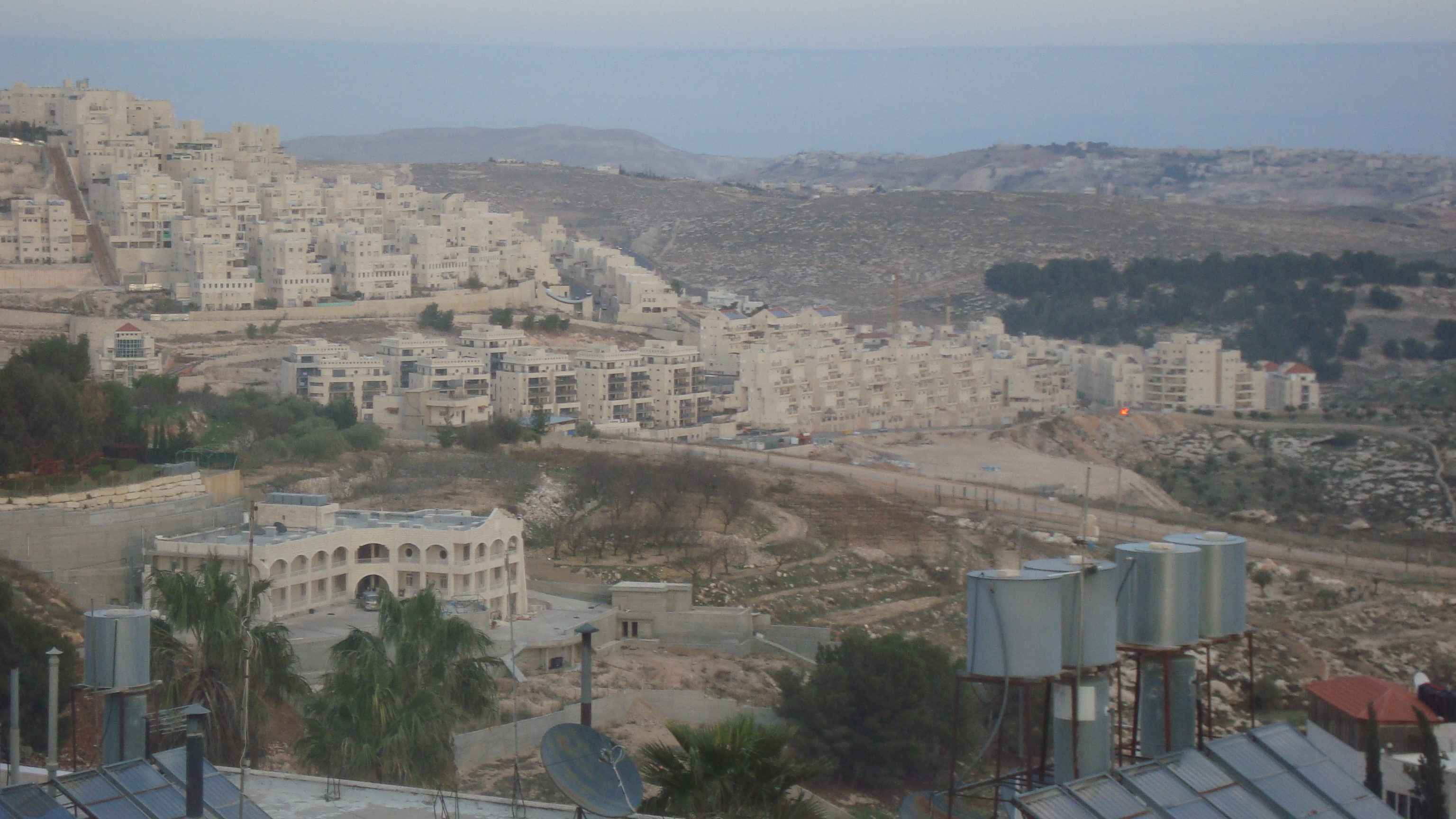
Har Homa (background) - Separation Barrier (midground) - Bethlehem (foreground) - 12 Jan. 2011 - Photo: Sherry Ann

Despite the curfew, the Giacaman family’s business survived. Elias has said that, “Like any Palestinian, we want to live in peace and to spend life as human beings with all of our rights. In 2011, we are living surrounded by walls. It’s not the thing you can do with humans. That’s not respect. Like animals inside a wall. What’s that?”

Last December, I was introduced to the Giacaman family by Ann Farr, an Ecumenical Accompanier placed in Yanoun in the West Bank. During that conversation, Joseph told us that finally, Elias had been granted a six-month work permit to visit Jerusalem and Israel for business purposes – after seven years of rejected applications. A few weeks ago, I returned to Bethlehem and had a chance to ask Elias about this seven-year effort, about Jerusalem, and about what this renewed access to Jerusalem means to him. He quickly set the discussion in the larger context of Palestine and Israel in 2010-2011.

“Jerusalem is the capital of Palestine, for all Palestinians. It has the Church of the Holy Sepulchre and Al Aqsa Mosque. It is part of religion. Without Jerusalem, the capital, we don’t have access. Jerusalem should be part of the solution that people are seeking to the conflict. They [those seeking to negotiate peace] want to create a state without a capital!”

Elias described that, prior to 2000 and the Second Intifada, people used to receive permission relatively easily to visit Jerusalem for religious feasts (e.g., Christmas) for a few days (e.g., 15 days). Now, however, only a proportion of people who apply receive permission (e.g., of 2000 people, only 500 would receive permits). If a family were to apply for this type of permit, possibly only one or two members would receive a permit.

Most people who are applying for permission to enter Jerusalem are applying for work permits. Before the Wall was constructed, soldiers used to let people go around the existing checkpoint in effect indicating, “Don’t let me see you.” However, that is no longer possible. “With the Wall, it’s more complicated now. Everybody needs permission if they want to work in Jerusalem. If soldiers catch a person without permission, that person would be arrested. Or, if they catch someone without a permit on a bus or in a taxi in Jerusalem, the driver may be arrested too, for three months. Very few people (among those who are labourers) have a permit to work every day in Jerusalem.”

“In general, for example with Palestinians who have to go to Jerusalem for work, they start standing in line at the [Bethlehem] checkpoint at 2:00 am. They are losing half of their lives. For example, for 20 years of their life, they are waiting at the checkpoint for six years.” People choose to do this for the chance of higher pay in Jerusalem (in Israel) compared with what can be earned in Bethlehem (in the West Bank). “For example, if they work in Jerusalem, they might earn 250 NIS [about $80 CDN] per day as a minimum. If they have a professional trade (e.g., as an electrician), they might earn 400 or 500 NIS [about $135-$165 CDN]. But in Bethlehem, they might earn only 80 NIS [about $25 CDN] per day. That is a really hard life.”

Elias’ permit, which he received in December 2010, is valid for six months. It is a business permit and allows him to go and come, from Bethlehem to Jerusalem and Israel. He anticipates that he’ll be doing this weekly for his family’s business, to meet with clients and to purchase goods that he can only get in Jerusalem or Tel Aviv. Now that he has received this initial permit, the likelihood that he’ll receive six-month permits in the future is good. A few years ago, the likelihood of receiving subsequent permits would have been low.

E. Giacaman - Bethlehem - 13 Jan. 2011 - Photo: Sherry Ann

From his perspective, Elias believes that Israel needs the Palestinians. “Nobody from either [Israeli or Palestinian] party wants the conflict to go on. People want what it was like before 2000.” 

“It’s more expensive for Israel to bring in foreign workers (i.e., from outside of Israel-Palestine) because they typically send their earnings back home. But Palestinians, even with spending their earnings in the West Bank, 40% of that money is spent on Israeli goods. So the money goes back into the economy. Palestinians are not a threat to Israelis.”

“Most people – Christian, Muslim, and Jews – we just want peace. In 2002, we were so close to peace.”

He referred to the Nakba (see this and this info), the Naksa, and the disappointment used to describe a missed opportunity for peace that arose in 2002. It is known as the Arab Peace Initiative (API) and was proposed in Feb. 2002, adopted by the Arab League in March 2002, incorporated into the ‘Road Map for peace’ in Dec. 2002, and then officially issued in 2003. The API was re-endorsed by the Arab League in 2007. As of 2009, the initiative was to be incorporated into President Barack Obama’s approach to the peace process. Given this week’s events in Tunisia and Egypt, the API may be very relevant still. For example, see this article published online on 28 Jan. 2011.

Upon reflection, Elias offered that, “Now, we have a kind of peace. We are moving toward peace, in that direction. We’re a few steps away from peace. Who knows when, but it could happen quickly within a two-week timeframe. It will depend on the right players in that moment in time.”

Thinking about the future of Jerusalem, Elias describes how, “The solution [to the Conflict] is that everything is connected. Jerusalem with the Al Aqsa Mosque and the Church of the Holy Sepulchre is connected.”

Elias’ vision for Jerusalem is that access would be like before 2000, not with the new borders as outlined by the Separation Barrier: “Palestinians are just looking for access to the Old City, not the new city. We are also seeking to enter Jerusalem, to work in Israel, to have a more comfortable life, a good way together [with Israelis].”

Praying for unity in this place

I’ve just come from the initial prayer service for the World Week of Prayer for Christian Unity. As an Ecumenical Accompanier, I was invited to attend to represent EAPPI and the World Council of Churches. The service was held in one part of the Church of the Holy Sepulchre:   Anastasis Chapel, Calvary, Greek Orthodox Office of “Apodeipnon” (Compline).

This slideshow requires JavaScript.

“The call for unity this year comes to churches all over the world from Jerusalem, the mother Church. Mindful of its own divisions and its own need to do more for the unity of the Body of Christ, the churches in Jerusalem call all Christians to rediscover the values that bound together the early Christian community in Jerusalem, when they devoted themselves to the Apostles’ teaching and fellowship, to the breaking of the bread and prayers. This is the challenge before us. The Christians of Jerusalem call upon their brothers and sisters to make this week of prayer an occasion for a renewed commitment to work for a genuine ecumenism, grounded in the experience of the early Church. They also ask us to remember them in their precarious situation and to pray for justice that will bring peace in the Holy Land.”

What an honour…to stand with others including so many clergy of various denominations, evident in the array of habit and dress…in such an old place…

Day by day in Jerusalem…

I’m struck by several fleeting yet unforgettable moments this day (18 Jan. 2011) in Jerusalem:

 -On the way to Qalandiya Checkpoint at 4:45 am with my EA teammate, Ruth:  The moon…setting in all her golden, near-full glory above the northwestern silhouette of the city…

-At Qalandiya Checkpoint at 7:30 am after a surge of frustrated men tried to squeeze into the too-narrow turnstile lines:  Another line of 20 Palestinian Muslim men stood and kneeled, shoulder-to-shoulder, in prayer…creating a counter-balancing calm…

-At tea with Georgette, a woman that I met on 2 January 2011 at the Greek Catholic Patriarchate near Jaffa Gate in the Old City. (See my posting on 2 Jan. 2011 at KidsStories4Peace). She lives with her husband, children, and grandchildren in a house that her family has owned for over 200 years in the Old City of Jerusalem. Over Arabic coffee, I asked her about life in the Old City and whether it was easier or harder under the Jordanian government prior to 1967…  “You know what’s easier? When you can go to sleep at night without worrying. Regardless of which government is in power.”

-Returning to the EA team house through the Old City:  A Palestinian Christian, funeral procession proceeding up the narrow street on foot, in community…

After the funeral procession - Christian Quarter, Old City, Jerusalem - 18 Jan. 2011 - Photo: Sherry Ann


-Evening tea with Ronny, a member of Machsom Watch, a group of peace activist, Israeli women who monitor the Israeli checkpoints. She is in the Israeli peace movement in part because she doesn’t like what the Occupation is doing to Israeli society. She said that she is “trying hard not to hate her society”…that was sobering…She is concerned that the Left has become marginalized. She offered some suggestions for us as we develop an EAPPI Fact Sheet on the Israeli peace movement.

  Life is rich here and sometimes overpowering. A friend from home has just shared the following with me and now I share it with you:

‎”When our days become dreary with low-hovering clouds of despair, and when our nights become darker than a thousand midnights, let us remember that there is a creative force in this universe, a power that is able to make a way out of no way and transform dark yesterdays into bright tomorrows. Let us realize the arc of the moral universe is long but it bends toward justice.” – Martin Luther King Jr.

“You develop a thick skin…”: Women in Black

For 23 years, the Women in Black have stood in Jerusalem on Fridays from 1-2 pm in Paris Square. Just a 15-minute walk from the Old City, five minutes from downtown, and a hundred yards from the Prime Minister’s residence, the square is anchored by a large, decorative water fountain. Israelis in non-violent protest first gathered around the square in early 1988 in response to the First Intifada – more specifically in response to the shooting and killing of Palestinians (teenagers) who had thrown rocks at Israeli soldiers.

Renate Wolfson, Woman in Black - Jerusalem - 10 Dec. 2010 - Photo: Sherry Ann

Renate Wolfson had joined a group of women and men on the south side of Paris Square; the group called itself, “Israelis By Choice” based on a shared experience of immigration earlier in their lives. As that group started to dissolve, she chose to join the Women in Black in the central part of the square where they continued to stand vigil.

The Women came together in January 1988, in vigil for the deaths of the Palestinian youth. They dressed and continue to dress in black as a sign of mourning. At that time, they were typically 150 women, standing shoulder-to-shoulder around the square every Friday afternoon (from 1-2 pm). Ten to twelve Women-in-Black groups existed at one point in Israel/Palestine.

The Jerusalem Women are not an organized group as such. They only meet to make decisions (e.g., regarding slogans they would use on their signs) and use a consensus-based approach to do so. At each vigil, the Women held, and continue to hold, signs in the shape of a black hand indicating, “stop”, with the words, “End the Occupation”, in Hebrew, Arabic, and English. During the attack on Gaza (Dec. 2008-Jan. 2009), they created a banner with the words, “Stop the siege of Gaza”.

Renate & Sherry Ann - Women in Black vigil - Jerusalem - 14 Jan. 2011 - Photo: Helen

During the first Gulf War (1990-1991), when Israelis started experiencing rocket attacks from Iraq (with hits on Tel Aviv and a few deaths), the Women in Black met to decide if they should continue to stand vigil on Friday afternoons. With many Palestinians siding with Iraq during the war, the women debated the future of their own vigil. They never reached a consensus. Finally, some women started standing again in Paris Square. At that point, though, the number of the members of the group began to diminish.

After the Oslo Accords, about 1995, the Jerusalem Women in Black stopped standing for six months. As Renate has recalled, “We thought that things were going to get better – that Israel would pull out of the territories and there would be peace. That turned out not to be true and so we came back”.

Since 1995, they have been gathering every Friday afternoon. They haven’t had a meeting since 1995. As the number of members has continued to drop, making decisions has become informal; the Women simply walk around the Square during their Friday vigils and ask each other about decisions they wish to make (e.g., Gaza banner).

Renate (at centre) - Jeff Halper (at left) - Jerusalem - 24 Dec. 2010 - Photo: Sherry Ann

Renate is one of the early members of the Jerusalem Women in Black. She was born in Germany and was 10 years old when she and her family moved to the USA. Her father had left for England in 1936 to find work abroad as a university lecturer. He taught philosophy of religion and studied how it is expressed in literature. Not finding work in England, he travelled to the United States. In between, he returned home to Germany. Renate remembers that he was disturbed by the changes in German society in his absence:

“It’s not that Jews weren’t allowed to talk on the street. They could talk about the weather. But NOBODY, Jewish or not, could talk critically about the Nazi (National Socialist German Workers’ Party) regime where he might be overheard. He could land in a concentration camp. The totalitarian regime took hold gradually and so my father after a year abroad wasn’t up to date and said things he could have said a year earlier, but no longer.”

The family lived with the threat that he might be arrested at any time. When he went abroad again, life became a little less anxious for them. However, life for Jews became ever more oppressive and threatening. Upon finding work in the US, he called for Renate, younger brother, and her mother to join him. The family left in August 1938, just ahead of the November 1938 Kristallnacht (i.e., Night of Broken Glass), a turning point in the persecution of Jews in Germany prior to the Second World War.

Renate moved in 1958 from the US to Israel. She worked “as a librarian at the Jewish National and University Library at the Hebrew University, and later part-time as an abstractor of German books and articles for a bibliography on antisemitism (books etc. ABOUT Antisemitism, not antisemitic books)”. She continued on the bibliography after she retired from the library and still does a little work for it. She married, in 1967, and had two children. Her husband died in 1986. When I asked why she moved to Israel, she recalled that,

“I was a Zionist. I had been in Israel in 1952-1953, after college, for a year of study (Jewish studies). I fell in love with Jerusalem. But now, I’m doubtful about Zionism. I am someone who loves Israel but I am very critical of what is happening.”

In reflecting on the past, Renate described how, “Our whole family – husband and children, have been active in the peace movement. We used to take the children along, when they were very young, to activities we thought suitable for them, such as planting new trees where settlers had uprooted Palestinian olive groves. My son, Yossi, a lawyer, worked until recently at HaMoked, a legal-aid center for Palestinians, and still does occasional work for them.”

In the early years of the Second Intifada (started in 2000) with suicide bombers targeting Israeli buses and cafes, the Women in Black continued to stand in Paris Square. I asked Renate if the Women were afraid while they stood vigil during that period, “We were not; it’s true that passersby became more hostile in their reactions, but we always had police protection.” In terms of life in general, she remembers being “a little afraid” but also recalls that if “you had to ride the bus, then you had to ride the bus”.  At times like that, “You can’t afford to be too afraid. You can’t give up coffee houses in the long run. That intifada lasted several years, until it died down gradually. After about a year and a half, the Israelis made a major campaign and invaded all Palestinian towns, house-to-house, arresting Palestinians wholesale. It was terrible but it put a partial stop to the terrorism. It was a high price to pay.”

After that spring-2002 campaign, Renate remembers that one Women-in-Black member’s daughter-in-law was killed by a suicide bomber and another member’s granddaughter was also killed in a separate incident. Both women continued to stand with the Women in Black. Renate went on to comment that the Separation Barrier is not a satisfactory resolution to the Second Intifada: “It is built in Palestinian territory separating Palestinians from their fields and from the centre of their lives regarding school, work, and medical treatment.”

In the last month in which I have had the honour to stand vigil with the Jerusalem Women in Black (and also on Friday with the Tel Aviv Women in Black), I have noticed that about 8 to 10 women appear each week.

Tel Aviv Women in Black - 31 Dec. 2010 - Photo: Sherry Ann

At least two internationals, like me and my Ecumenical Accompaniment  teammates, also appear. On some days, up to 10 or 12 additional people stand and they have included two or three men. Renate, herself, has commented on the older age demographic of the Women. They are now all older women with one exception. A younger woman started standing with them about six or seven years ago. She has since had a son who has become part of the vigil group, too. Their oldest member just celebrated her 89th birthday. As the Women marked their 23rd anniversary last week, they have discussed the need to recruit new members. They also know that since 1988, Israeli women have branched out from the Women in Black effort to form other peace groups (e.g., Machsom Watch). “Now,” Renate observed, “only those of us who can’t do other things continue to stand vigil here.”

I asked Renate how she and the other Women cope each week with being called “traitor” by drivers and pedestrians moving through Paris Square. She says, “You develop a thick skin and you don’t really have much respect for people who talk that way.” Now is not an easy time, compared with the Oslo years, to be a member of the Israeli peace movement. As Gideon Levy, the Israeli journalist, has observed, “The Israeli Left collapsed totally and dramatically ten years ago…” (28 Dec. 2010, Alternative Information Centre event). Last week, he reported that, “The Knesset has resolved to create a parliamentary committee of inquiry to look into the activities of left-wing groups ‘and their contribution to the delegitimization campaign against Israel.’ Such a panel would make even Senator Joseph McCarthy blush” (Levy, 6 Jan. 2011). Not only are accusations of “anti-semitism” flying about but also criticisms that standing for a just peace somehow delegitimizes the Israeli state (e.g., see this article from 29 December 2010). In response, Renate has noted the following for me:

My past as a Jew in Nazi Germany, as well as my present work on the history of antisemitism, make me especially sensitive to the oppression of others and to the need for citizens to act against unjust regimes before it’s too late.

My father, by the way, supported (long-distance, from Germany and the US) a group called Brit Shalom and later Ihud in what was then Palestine, (i.e. before Israel’s independence), consisting mainly of German and American Jewish academics, that worked for Jewish-Arab understanding and for a binational state. (I don’t think a binational state is feasible any longer after all that’s happened and all the hostility that created.)”

Renate Wolfson, Woman in Black - Jerusalem - 14 Jan. 2011 - Photo: Helen

What does Renate hope for the future, in particular for Jerusalem, the city with which she fell in love in 1958?

That it would be partitioned with the eastern part serving as the Palestinian capital and the western part as the capital of Israel. Yet, I hope very much that there wouldn’t be a wall in the middle so that we can go back and forth.”

For more information about the Women in Black’s early years, click here. For information about Women in Black International, click here.